
Trump’s Muslim Brotherhood ban is a blunt answer to the Gaza genocide


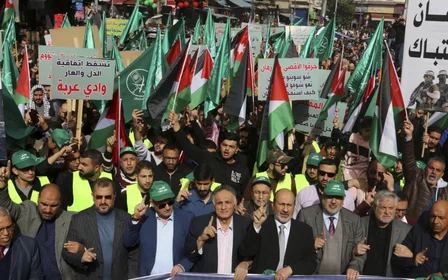
Late last month, the Trump administration announced it was launching a process to designate the Muslim Brotherhood as a terrorist organisation, beginning with three of the movement's "chapters" in Egypt, Jordan and Lebanon.
In its response, the Egyptian organisation defended its record of nonviolent activism and charged US officials with giving in to external pressure by pursuing a move long sought by Israel and several authoritarian Arab regimes.
The statement further stressed that during its brief time in government, the Muslim Brotherhood "worked closely with the US to uphold regional stability and advance diplomatic efforts for peace".
The recent move raises several significant questions regarding its timing, how this latest effort compares with previous attempts to designate the Muslim Brotherhood, and what unintended outcomes it may produce.
In the wake of the two-year genocide in Gaza, the designation would appear to shift the conversation away from ongoing Israeli atrocities, even in the midst of a ceasefire agreement, and revive the global "war on terror" framework that animated much of US domestic and foreign policy for more than two decades.
New MEE newsletter: Jerusalem Dispatch
Sign up to get the latest insights and analysis on Israel-Palestine, alongside Turkey Unpacked and other MEE newsletters
Throughout that time, the "Muslim Brotherhood" label frequently served as a catch-all term among the US and European right to justify securitisation measures and crackdowns on civil society at home, while ramping up support for authoritarian regimes abroad.
Absent any discussion of this broader context, the move appears quite puzzling, reflecting a deep disconnect with the movement's history and current reality.
Origins and evolution
Founded by a schoolteacher in interwar Egypt, the Muslim Brotherhood emerged as a movement dedicated to social change.
In a rapidly modernising region still reeling from the collapse of the Ottoman Empire and the abolition of the caliphate, Hassan al-Banna proposed a vision of Islamic revival rooted in a popular social movement rather than staking its hopes on political or religious elites.
In time, he argued, as Muslim societies began to reflect the core values of their religious tradition, their political, economic and cultural institutions would gradually internalise those values as well.
So internalised was the Muslim Brotherhood's reformist ethos that it initially rejected the revolutionary wave sweeping the region until it became a lived reality
The organisation gained a significant following, in part, for its ability to address the failures of the post-colonial states that emerged throughout the region.
By the end of World War II, the Brotherhood in Egypt had more than a million followers, and many other Arab countries had established their own branches.
Rhetorical references to Muslim unity notwithstanding, these organisations emerged explicitly along nationalist lines and limited their missions to their state boundaries.
Despite immense pressure from secular authoritarian rulers, the movement continued to thrive. It came to dominate student unions and professional syndicates and, where permitted, contested parliamentary elections.
The Muslim Brotherhood also established a robust social welfare network, frequently stepping into the breach left by neo-liberal economic policies and the shrinking of state support for education, medical care and other essential services.
Frustrated by the lack of progress on its reformist agenda, some members occasionally abandoned the movement to pursue a more confrontational, and at times militant, strategy. Throughout those challenges, and even in the face of severe state repression, the organisation never wavered from its core commitment to gradual change.
In fact, when the Arab uprisings erupted in late 2010, the Muslim Brotherhood was caught off guard. So internalised was its reformist ethos that it initially rejected the revolutionary wave sweeping the region until it became a lived reality, to which the movement eventually and reluctantly acceded.
Muslim Brotherhood-affiliated political parties made major gains in the first free and democratic elections in the region, from Tunisia to Yemen. They won both a parliamentary majority and the presidency in Egypt.
But the experiment in democratic governance proved incomplete and short-lived. In 2013, the Egyptian military launched a coup against President Mohamed Morsi, and weeks later committed a brutal massacre of his supporters at a peaceful sit-in at Rabaa Square in Cairo.
Follow Middle East Eye's live coverage of Israel's genocide in Gaza
The counter-revolution rolled back the brief democratic gains of the popular protest movements, with resurgent authoritarian rulers taking power in Egypt and Tunisia, while Libya, Syria and Yemen descended into destructive civil wars.
Outlawing the Muslim Brotherhood frequently served as a pretext to crack down on civil society more broadly. Regimes invoked the movement with every proclamation of emergency laws, the closure of charitable institutions, the shutdown of newspapers and websites, and the enforcement of bans on public gatherings.
US pressure and regional politics
By every metric, civic freedoms and human rights in the Arab region are far worse today than they were a decade ago.
It was during this period that the first Trump administration came into office, promising to explore the possibility of designating the Muslim Brotherhood as a terrorist organisation, a core demand of a small but influential segment of Trump's domestic and foreign supporters.
A similar review in the UK in 2015, conducted at the urging of the United Arab Emirates, resulted in the British government finding no grounds upon which to issue such a declaration and concluding that it would likely hinder the state's diplomatic options in the region.
Similarly, dissenting voices within the first Trump administration argued that a designation would present too many legal complications and undermine US diplomacy. The organisation's branches are independent of one another and exist in vastly different political contexts.
In countries such as Bahrain and Jordan, two US allies, Muslim Brotherhood-affiliated parties have frequently served to bolster regime legitimacy and have held key government posts.
In Tunisia, the Ennahda Party, which traces its roots to the Brotherhood's regional expansion more than half a century ago, was then in government, placing the future of US-Tunisian relations in jeopardy.
Even in other stalwart US allies, such as Morocco and Turkey, although they did not have formal Muslim Brotherhood organisations, the movement's intellectual tradition had a deep impact on the ruling political parties.
While the proposal was shelved, particularly after Trump's 2020 election defeat, it continued to serve as a rhetorical device among some Republican lawmakers.
They pledged to find ways to outlaw the organisation as part of a broader crackdown on Muslim civil society groups in the US, often in alignment with Arab allies seeking to consolidate power by stripping their societies of any organised political opposition.
Just before the White House released its statement, Texas Governor Greg Abbott issued his own declaration designating both the Muslim Brotherhood and the Council on American-Islamic Relations, a domestic advocacy organisation, as foreign terrorist organisations.
Days later, Florida Governor Ron DeSantis followed suit, issuing an identical designation and escalating what appears to be a state-level campaign against Muslim civil-society organisations.
While it remains unclear what jurisdiction state governments have in enforcing such decrees, the intent appears to be to paint the longstanding American-Muslim community as a foreign entity tied to extremism and to paralyse the institutions most committed to representing it in the public sphere.
Beyond the designation
A key reason why the recent designation was pushed through in a way that had not been feasible previously is that, rather than provide a compelling case, the accompanying documentation was remarkably light on facts.
Beyond a few vague assertions and scattered allusions, there is little in Trump's statement that offers evidence to justify the designation in a manner normally expected for such a massive policy shift.
The assumption, it would seem, is that a groundswell of sensationalistic reporting and Islamophobic content, amid a polarised regional and global climate after the Gaza genocide, now allows such a policy to be proclaimed without meeting even a minimal evidentiary standard.
Nor is the Muslim Brotherhood the only intended target. The current state of the movement regionally suggests it is far from a key actor in ongoing political struggles.
In Egypt, tens of thousands of members remain imprisoned. Figures in exile have endured a very public internal split over the organisation's leadership.
In Tunisia, the Ennahda Party has been outlawed and most of its leading members, including its 84-year-old leader Rachid al-Ghannouchi, have been imprisoned.
Although the Syrian Muslim Brotherhood played a role in international efforts to topple Bashar al-Assad, the organisation has been largely excluded from the post-Assad rehabilitation of Syria, ironically shepherded by a leading figure from an expressly militant Islamic movement.
In Jordan, Kuwait and elsewhere, previously accommodationist policies allowing these parties limited participation have been eroded, leaving little possibility that they can continue to take an active part in public life.
The administration appears to have placed all its stock in the viability of authoritarian regimes, with little interest in understanding the needs and demands of Arab civil society
The past decade has been the most challenging in the movement's nearly century-long history. Its existential crisis has revived long-simmering questions about the organisation's future, its ideological programme and its place in society, particularly given the violent foreclosure of nearly all avenues for participation.
The US designation will only further alienate a younger generation unsure of their place in this regional order, where the values of democracy and human rights are all but buried.
For US officials, this decision severely limits future policy options. Its approach to regional diplomacy is likely to become subsumed within national security and counter-terrorism frameworks.
The administration appears to have placed all its stock in the viability of authoritarian regimes, with little interest in understanding the needs and demands of Arab civil society, of which the Muslim Brotherhood movements are only one actor.
The implications of this policy, therefore, extend beyond the fate of a particular political actor with a deep history of activism, advocacy and participation. They concern a civil society that has become increasingly narrow and subject to intensifying repression, both within the region and beyond.
The views expressed in this article belong to the author and do not necessarily reflect the editorial policy of Middle East Eye.
Middle East Eye delivers independent and unrivalled coverage and analysis of the Middle East, North Africa and beyond. To learn more about republishing this content and the associated fees, please fill out this form. More about MEE can be found here.