Syria’s recovery under al-Sharaa is vital for Turkey, and Israel poses the biggest danger

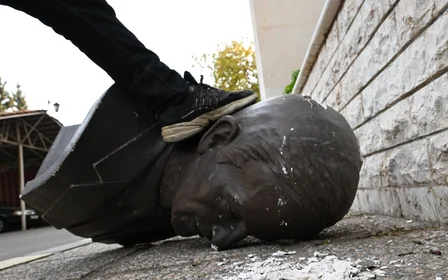
The fall of Syrian President Bashar al-Assad in December 2024 was not just an instance of regime change; it marked a major shift in regional geopolitical dynamics.
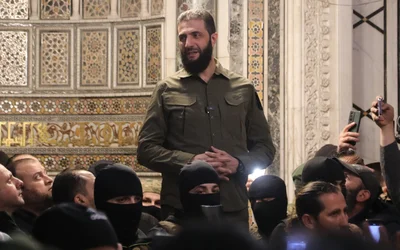
One year later, Syria is carefully moving away from the abyss, but its footing remains precarious. Under the leadership of President Ahmed al-Sharaa, the country is transitioning from an international pariah to a state focused on internal stability, regional reintegration and global recognition.
Yet significant challenges remain, including a limited number of supportive regional players, and several disruptive elements - with Israel acting as a major spoiler.
Turkey, meanwhile, has emerged as one of the few committed regional actors supporting the new Syria, playing a crucial role in its stability, security and prosperity.
As this year comes to a close, 2026 will be a crucial test for the new Syrian government. The country’s fate increasingly hinges on strengthening ties with allies, while effectively countering those who seek to undermine the post-Assad order.
New MEE newsletter: Jerusalem Dispatch
Sign up to get the latest insights and analysis on Israel-Palestine, alongside Turkey Unpacked and other MEE newsletters
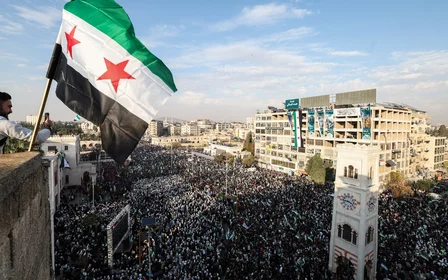
The past year has witnessed monumental change in Syria, as the political and security environment has improved since the final, brutal years of Assad’s rule. Nearly three million Syrians have returned home - including around one million refugees and 1.8 million internally displaced persons - in a testament to their growing, albeit cautious, confidence in the future.
The Sharaa government’s pragmatic foreign policy, which has prioritised deescalation, stability and reconstruction, has led to rapid normalisation with regional and international actors. Internally, the focus has been on moving from revolutionary legitimacy to institutional legitimacy.
This involved a general amnesty for military personnel conscripted into service under Assad, amid a strategy of rapid institutional overhaul balanced with centralised control, including a constitutional declaration and a new parliament.
Returning to the Arab fold
Economically, decision-making has been consolidated under a new Supreme Council for Economic Development, which launched sovereign funds for reconstruction and enforced banking compliance standards. Western sanctions have been dropped.
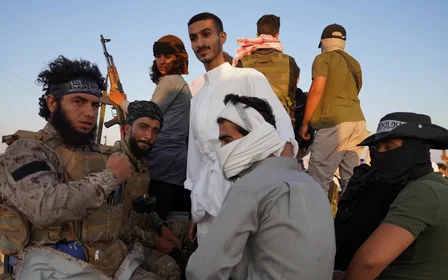
On the security front, the government moved to monopolise the use of force by dissolving the notorious Mukhabarat in favour of the General Security Service, and by aggressively integrating disparate rebel factions into a unified national army.
Regionally, Syria has successfully returned to the Arab fold, with Qatar and Saudi Arabia emerging as committed allies. During his first year in power, Sharaa also made unprecedented foreign visits, including a historic trip to the US, alongside meetings in France and Russia. This helped to facilitate the removal of sanctions, while bolstering Syria’s reintegration into the international community.
Syria's social fabric, shredded by years of conflict, remains vulnerable to sectarian and ethnic tensions, often stoked by external disruptors
Among the key actors committed to a stable and prosperous new Syria is Turkey. The fall of the Assad regime has transformed relations with Ankara into a vital partnership, driven by shared interests in border security, economic success, refugee management, and countering common threats.
Turkey has thus emerged as the primary external actor shaping the new Syria. By providing essential political, economic and security assistance, including advocating to lift global sanctions, Turkey has played a crucial role in preventing the collapse of the Syrian state and fostering stability.
For Ankara, the stakes are existential. A stable and friendly Syria is essential for addressing Turkey’s primary security challenges, including the refugee crisis and the threat from the Kurdish People’s Protection Units (YPG) along their shared border. Yet while Syria’s sovereignty and territorial integrity are closely linked with Ankara’s own security interests, supporting Syria’s stability - without becoming entangled in its internal conflicts - requires careful diplomacy.
Massive humanitarian crisis
At the same time, Syria’s leadership faces formidable challenges. The task of rebuilding a nation shattered by war is staggering. With reconstruction costs potentially reaching $1 trillion, and with millions of Syrians still displaced, the scale of the humanitarian and economic crisis is immense.
Politically and socially, the fall of the Assad regime deprived certain entrenched minority groups of their long-held privileges, creating a class of saboteurs who are actively seeking - under creative pretexts, such as democracy, decentralisation and inclusive government - to undermine the new order and reclaim their lost status.
Syria’s social fabric, shredded by years of conflict, remains vulnerable to sectarian and ethnic tensions, often stoked by external disruptors - chief among them Israel, which is trying to further weaken Syria and grab more of its territory.
The path to a stable, unified and democratic Syria is thus actively threatened by a host of actors who see a peaceful outcome as detrimental to their own interests. The most significant internal threat comes from the YPG in the north, followed by a group within the Druze minority in the south - both openly supported by Israel - along with Assad loyalists in the west and what remains of Daesh activity.
Despite the Syrian government’s formal agreement with the YPG, which entails a plan to integrate its members into the national army, the Kurdish group has slow-walked the disarmament process amid visible support from foreign actors. This has fuelled clashes between the YPG and state forces, raising fears of a new front opening in the conflict.
Externally, Israel remains the most determined and dangerous actor. Tel Aviv has pursued a strategy of turning the new Syria into a failed state, aiming to ensure its own regional dominance and to maintain its occupation of the Golan Heights.
Throughout the past year, Israel has conducted air strikes and offered its support to minority groups, in hopes of undermining the new government and ensuring a permanently debilitated Syrian state. Iran's influence has waned since the fall of Assad but it could attempt to regain leverage.
Competing forces
Looking ahead to 2026, Syria’s trajectory will be defined by the push and pull of these competing internal and external forces. A dramatic breakthrough to full stability and prosperity is unlikely, as is a catastrophic collapse into renewed all-out war. The most plausible scenario is a continuation of incremental progress in the face of severe challenges.
We can expect the Syrian government, with Turkey’s steadfast backing, to continue the slow and arduous process of state-building and economic reconstruction. The integration of the YPG will remain the most critical and volatile flashpoint; should the Kurdish group continue to stall, a military confrontation seems inevitable.
In such a scenario, Turkey may intervene directly to act as a counterweight against Israeli meddling. Ankara could offer crucial support to the Syrian army to degrade the YPG’s military capabilities and erode its control over territory. While this would be a violent process, Damascus and Ankara would likely view it as a bitter necessity to secure Syria's security, sovereignty, and territorial integrity.
On the economic front, Syria may see prolonged difficulties before the situation starts to improve. Reconstruction efforts, which will require external investments, cannot be undertaken by the Syrian leadership alone.
Diplomatically, Syria will continue its journey of reintegration into the regional and international fold. But these processes could be significantly hampered if Israel continues its occupation and intervention in Syria, or if the positions of western nations shift.
The relationship between Damascus and Ankara will remain the cornerstone of Syria’s future. But all stakeholders - from Syrian citizens to international observers - must harbour realistic expectations. The journey ahead will be long, arduous and fraught with peril. Patience and commitment will be paramount, as will vigilance against the disruptive forces, both internal and external, that seek to derail Syria’s march towards a new era.
The views expressed in this article belong to the author and do not necessarily reflect the editorial policy of Middle East Eye.
Middle East Eye delivers independent and unrivalled coverage and analysis of the Middle East, North Africa and beyond. To learn more about republishing this content and the associated fees, please fill out this form. More about MEE can be found here.