Azerbaijan's hijab ban sparks outrage in Turkey as women recall past restrictions

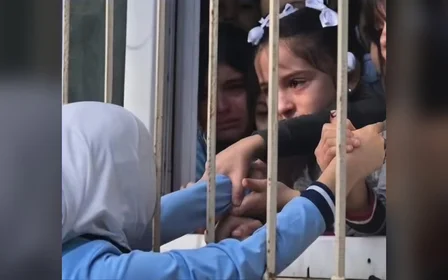
Azerbaijan's restrictions on Islamic headscarves in schools have sparked this week a wave of condemnation in neighbouring Turkey, where scenes of girls being turned away from classrooms have revived painful memories of the country's own history of hijab bans.
Many Turkish social media users recalled their own experiences of discrimination during decades of restrictions on headscarves in Turkish universities and public institutions, following the military intervention of 28 February 1997, known as the "postmodern coup".
Thousands of women faced barriers to education and employment because of their religious clothing.
New MEE newsletter: Jerusalem Dispatch
Sign up to get the latest insights and analysis on Israel-Palestine, alongside Turkey Unpacked and other MEE newsletters
“What the Turkish public experienced decades ago is now being mandated on the Azerbaijani people,” one commentator said in a video shared on Instagram.
On 21 September, Azerbaijan amended school uniform regulations, prohibiting clothing deemed incompatible with school uniforms and the secular principles of education.
Although the regulations do not explicitly mention the hijab, the enforcement has seen headscarf-wearing students barred from classrooms, while some teachers have reportedly been told to remove their headscarves or risk losing their jobs.
Videos circulating online show students protesting in solidarity with affected classmates, as demonstrations spread across Azerbaijan.
On 12 October, Azerbaijani authorities announced that 37 people had been detained in connection with protests and incidents surrounding the enforcement of the new rules.
Azerbaijani officials have defended the restrictions as necessary to uphold secular education and preserve the country's cultural identity.
The controversy has brought wider questions of national and religious identity to the forefront, amid arguments that the hijab represents foreign religious influences rather than Azerbaijani cultural traditions.
It has raised questions as to what forms of religious expression are acceptable in public education in a country that upholds a secular identity.
A painful chapter in Turkey's history
In the period following the Turkish military intervention of 28 February 1997, headscarf-wearing students were barred from universities, and women working in public institutions faced dismissal if they did not uncover their hair.
Women were forced to choose between pursuing their education and professional careers or following their religious beliefs. Some sought opportunities to study abroad after Turkish universities excluded them.
“What is happening in Azerbaijan right now reminds us of what Turkey has experienced in its near past," Turkish journalist Hatice Orhan said in a video shared on Instagram.
"Women wearing headscarves in Turkey were subjected to various kinds of cruelty; there were a lot of women who could not go to school, perform their professions, or were forced to postpone their dreams.”
The restrictions were gradually eased in subsequent years, with barriers to headscarf-wearing university students removed around 2010 and the ban on most female civil servants lifted in 2013.
But the issue remains deeply embedded in the country's political memory, continuing to shape discussions about secularism, religious freedom and discrimination, long after the formal restrictions were lifted.
The experiences of women excluded from education and public life during that period continue to resonate across generations, provoking strong reactions to developments in Azerbaijan.
xxxxxxxx
“How is it possible in 2026 that in a Muslim country, a student is blocked from performing their religious duties?" Turkish content creator Gulben Tankus said in an Instagram video.
"We in Turkey searched for the answer to this question for decades. How can we accept that such news is emerging from a country that we call our brothers and sisters?”
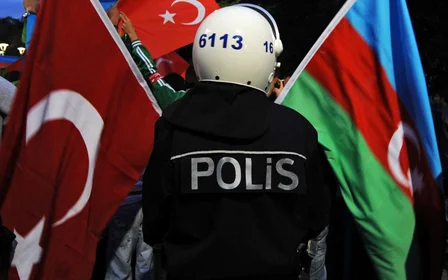
Solidarity has extended beyond social media, with demonstrators gathering outside Azerbaijan's consulate in Istanbul earlier this month to call for an end to the restrictions.
Tensions between close allies
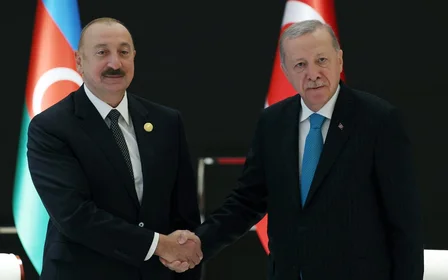
The controversy exposed tensions between Turkey and Azerbaijan, two close allies that frequently describe their relationship as "one nation, two states".
Turkish presidential adviser Oktay Saral and lawmakers from the governing Justice and Development Party have criticised Azerbaijan's restrictions, prompting a strongly worded response from the country's ruling New Azerbaijan Party.
In a statement issued on 13 October, the party accused Turkish political figures of interfering in Azerbaijan's internal affairs and disregarding the country's constitutional commitment to secularism.
It defended the country's education policies grounded in equality, secularism and the rule of law, arguing that secularism was also enshrined in Turkey's constitution.
The party accused Turkish officials of exploiting a sensitive issue for political purposes and rejected suggestions that the close relationship between the two countries gave Ankara the right to influence Azerbaijan's domestic policies.
Middle East Eye delivers independent and unrivalled coverage and analysis of the Middle East, North Africa and beyond. To learn more about republishing this content and the associated fees, please fill out this form. More about MEE can be found here.