Gaza genocide leaves record number of orphans and widows

Every two days, the three Abu Asser siblings move from one aunt’s tent to another, a routine that began after they were orphaned days into the ceasefire in Gaza last year.
Mariam, 16, Aya, 14, and Jebril, 12, lost their father during Israel’s 2014 offensive on Gaza.
After their home in Gaza City was destroyed during the Israeli genocide that began in 2023, they sought refuge with their mother, Islam, in a makeshift tent in Deir al-Balah, central Gaza.
Nineteen days after the ceasefire agreement took effect on 10 October 2025, an Israeli bomb struck their tent, killing their mother before their eyes.
The Palestinian siblings are among 54,468 children in Gaza who have lost one or both parents since the genocide began in October 2023, according to the Palestinian Ministry of Social Development in Gaza.
New MEE newsletter: Jerusalem Dispatch
Sign up to get the latest insights and analysis on Israel-Palestine, alongside Turkey Unpacked and other MEE newsletters
Two of the aunts caring for them are also raising their own children alone after losing their husbands during the genocide.
“The children don’t have a stable home. They mainly stay with their paternal grandmother, but they keep moving between us [their maternal aunts], spending two nights at a time with each aunt,” Warda al-Muzeini, their widowed aunt, told Middle East Eye.
'In the blink of an eye, I was left without a family'
- Wafaa al-Attar, orphaned child
“We try to support them emotionally, especially the youngest, Jebril, who was sitting in his mother’s lap when the bomb struck and was himself injured.
“He saw his mother die in front of him.”
Muzeini lost her husband in an Israeli air strike during the genocide. She is now raising their four children alone.
Without a job or reliable income, she struggles to provide even one meal a day.
“My widowed sister and I are already struggling to put food on the table for our own children. But we also have to care for our sister’s children, who have no one else,” Muzeini said.
“We share the responsibility. Each of the three sisters buys something for the children whenever we can. One buys pyjamas, another buys slippers, and another gives them enough pocket money for a couple of days.”
A childhood lost
Across Gaza, there are at least 64,000 widows and 71,000 orphaned children.
The figures include those bereaved during the genocide and those who lost spouses or parents in earlier Israeli military attacks on Gaza.

According to the Ministry of Social Development’s orphan registration system, around 3,000 children have no registered guardian, custodian or caregiver.
“The figures don’t really capture the daily suffering of these groups in Gaza,” Aziza al-Kahlout, a spokesperson for the ministry, told MEE.
“A child who has lost both parents has not only lost care and safety, but has also been deprived of education and childhood, forced to shoulder responsibilities far beyond their years.”
Women who become their families’ sole breadwinners face the double burden of providing for their children and raising them amid the devastation left by the war, Khalout added.
She warned that orphaned children face a greater risk of dropping out of school and early marriage amid worsening economic and humanitarian conditions and a lack of adequate shelter.
“There are deeply alarming signs of growing risks of child labour, school dropout and early marriage in Gaza, driven by poverty, displacement and the loss of family breadwinners,” she said.
A family wiped out
For children left as their families’ sole survivors, the loss carries another cruelty: they must grieve their parents and siblings alone, with no one to share their memories or pain.
Among them is Wafaa al-Attar, who went from daughter and sister to orphan and her family's sole survivor in five minutes.
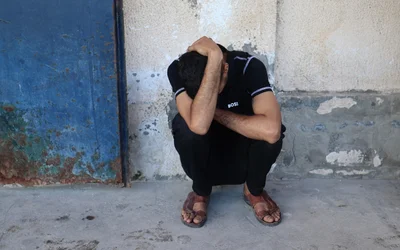
She was 10 when she stepped out to charge her father’s phone at her uncle’s nearby home.
While she was away, an Israeli air strike levelled her family’s home in Deir al-Balah, central Gaza, killing her parents and all four of her siblings.
“In the blink of an eye, I was left without a family,” Attar, now 13, told MEE.
“My father was on the phone when the battery died. He told me to charge it at my uncle’s home because he had solar panels, and just as I was about to enter, there was a massive blast,” she recalled.
“I turned around, and our home was no longer there.”
The strike took place on 22 February 2024, hitting a multi-storey building the family was in, killing Attar’s father, Ahmed, her mother, Khouloud, and her four siblings: Rital, eight, Muhammed, five, Obada, three, and nine-month-old Yazan.
Attar suffered minor shrapnel injuries and was taken to hospital. She did not yet know what had happened to her family. She kept asking, but no one answered until her uncle arrived.
“He told me, ‘May God have mercy on them. May God compensate you,’” she recalled.
She stopped crying and fell silent, unable to process what she had heard. The shock lasted for two or three hours, until she returned to her uncle’s home.
“Then I kept thinking: ‘All of them at once?’”
For months, Attar struggled to comprehend the loss and feared what lay ahead. Initially, she stayed with her grandparents, wondering how she would survive without her family.
'No one could ever replace my own family'
-Wafaa al-Attar, orphaned child
“I had breakdowns. For months, I wished I had been with them in the house when it was bombed. I wished I had been killed with them,” she said.
She was also left without her siblings to share the grief. “I didn’t even have the chance to speak to my siblings about it.”
Eventually, Attar moved in with her uncle, his wife and their newborn baby. Their support helped her cope with the loss, though the grief remained.
Whenever she broke down, her uncle’s wife comforted her and reminded her that her father would want her to stay strong.
“They made things easier for me. I could see how they tried to support and comfort me,” Attar said.
“But of course, I know that no one could ever replace my own family."
Middle East Eye delivers independent and unrivalled coverage and analysis of the Middle East, North Africa and beyond. To learn more about republishing this content and the associated fees, please fill out this form. More about MEE can be found here.