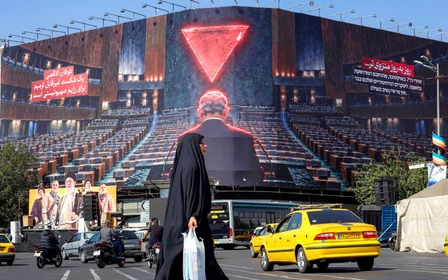
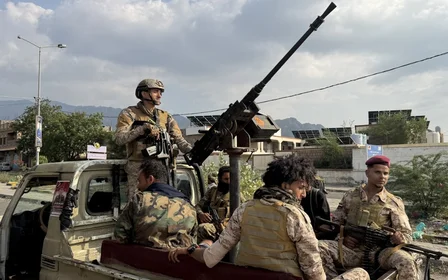
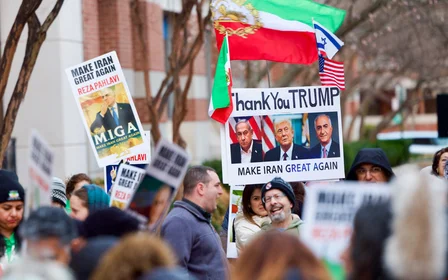
Iran warns of ‘unimaginable’ response to US aggression as tensions rise over Hormuz

Iran has issued a warning to the United States that any new act of militarism would lead to an "unimaginable" response, with parliament speaker Mohammad Baqer Qalibaf saying that Iran would not back down if attacked.
Addressing parliament, Qalibaf said the Iranian government would not be intimidated by US military threats or pressure and would defend what it considers the country’s territorial integrity.
“Americans think that with a few levers of media pressure or military threats, they can make this great nation surrender to them,” he said, according to a report by Iran’s Tasnim news agency.
“Unaware that today's Iran is not the Iran of the Pahlavi era of humiliation, but rather an impregnable fortress of self-confidence, defensive strength and iron will,” he added.
Qalibaf said Iran was prepared to respond forcefully to any violation of its territory and insisted that threats of a wider war would not compel the country to abandon its interests.
New MEE newsletter: Jerusalem Dispatch
Sign up to get the latest insights and analysis on Israel-Palestine, alongside Turkey Unpacked and other MEE newsletters
“Until the Americans change their behaviour, stop being coercive and greedy, and compensate their violated obligations in an objective, concrete and real way on the ground, no claim for the Islamic Republic of Iran will have an iota of credibility,” Qalibaf said.
Qalibaf said Washington had placed itself in a tough spot due to its decisions to attack Iran.
The warning came a day after US President Donald Trump said Washington could strike Iran as soon as Sunday or reach a “big, beautiful” agreement with Tehran, as tensions rise over the future of the Strait of Hormuz.
On Sunday, Iran’s army said that its air defence systems had shot down a US LUCAS drone over Bandar Abbas, a port city in southern Iran near the Strait of Hormuz.
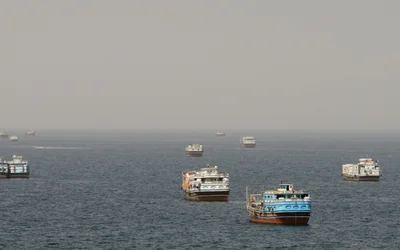
Iranian Foreign Minister Abbas Araghchi said the war with the US and Israel means the security situation in the region has completely changed and that the management of the strait would not return to its previous state.
“The current war has changed everything. We must acknowledge that new realities have emerged,” Araghchi said in remarks reported by Anadolu Agency, citing Iran’s Press TV.
“The shipping routes through the Strait of Hormuz will no longer be the same as before, nor will the strait be managed as it was in the past,” he added.
Araghchi said Tehran would welcome security arrangements developed by countries in the region rather than imposed by outside powers.
The waterway, between Iran and Oman, is one of the most important in the world. It connects the Persian Gulf to the Gulf of Oman and the Arabian Sea. Its security is crucial to international energy shipments.
Iran and the US remain at odds over how the strait should be managed following the conflict. Tehran has asserted its authority over passage through the waterway, while Washington has called for unrestricted navigation.
However, although there was an interim deal signed between the two nations in June to solve the conflict, diplomatic negotiations have since stalled amid renewed tensions.
Middle East Eye delivers independent and unrivalled coverage and analysis of the Middle East, North Africa and beyond. To learn more about republishing this content and the associated fees, please fill out this form. More about MEE can be found here.