'Null and void:' Egypt condemns Turkey-Libya maritime deal, reaffirms pact with Greece

Egypt has declared a contentious maritime deal sealed by Turkey and eastern Libya as “null and void, absolutely”, reaffirming its commitment to an agreement it sealed with Greece.
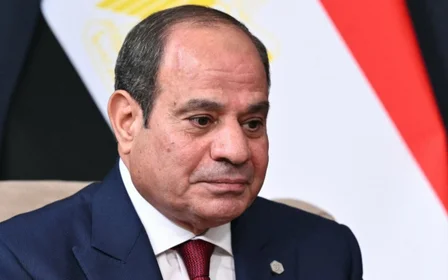
Egypt’s foreign ministry on Wednesday “reiterated that the memorandum is null and void, carries no legal effect, and that its ratification by the Libyan House of Representatives entails no legal consequences whatsoever for Egypt”, according to a statement.
Egypt’s statement marks a show of support for Greece, a longtime partner in the Eastern Mediterranean, and underscores Cairo’s own reservations about the Turkish agreement, which directly contradicts one it reached with Athens.
Turkey’s eastern parliament surprised many on Tuesday by unanimously approving a contentious maritime deal with Turkey that it had opposed for years. The agreement was first approved by Libya’s Tripoli-based government in 2019.
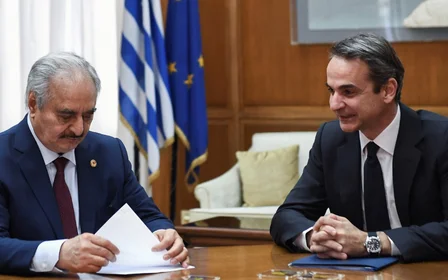
Eastern Libya is controlled by Khalifa Haftar, a general who previously was at war with Tripoli's government. Turkey provided weapons, soldiers and mercenaries to help Tripoli defeat Khalifa’s military offensive in 2019. Khalifa was backed by Saudi Arabia, the UAE and Egypt.
New MEE newsletter: Jerusalem Dispatch
Sign up to get the latest insights and analysis on Israel-Palestine, alongside Turkey Unpacked and other MEE newsletters
But in the last several years, Khalifa’s son and heir apparent, Saddam, has forged a closer relationship with Turkey. Saddam welcomed the ratification of the maritime deal in a social media post on Tuesday.
Sources tell MEE that Saddam is seeking Ankara’s support for a wider power-sharing deal in Libya with the rulers of Tripoli.
Turkey’s 2019 deal with Tripoli unnerved Greece and Egypt, as it would cement sweeping Turkish claims over the Eastern Mediterranean.
In response, Greece demarcated its maritime borders with Egypt in 2020, directly contradicting the Turkish deal.
Cairo’s rejection of the deal is notable because it is generally seen as close to eastern Libya’s government. When Greece and Egypt demarcated their maritime zones, Egypt and Turkey had rockier relations.
In recent years, they have undergone a rapprochement that has seen them cohere on flashpoints like the Horn of Africa.
Last year, Greece sought Egyptian support to forestall eastern Libya’s ratification of the maritime deal.
An Egyptian delegation visited Athens days ago to confer with Greece on Libya.
Although Egypt was unable to prevent Eastern Libya’s ratification of the agreement, Cairo’s statement will be welcomed in Athens.
Why is the Turkish-Libya maritime deal controversial
Several components make up Greece and Turkey’s decades-old maritime feud.
Under international law, countries are generally permitted to claim up to 12 nautical miles of sovereign territory at sea or up to a median line when maritime claims overlap.
Greece has not done so in the Aegean, where it has hundreds of islands, because in 1995 Turkey’s parliament declared that extending its territorial waters would constitute a "casus belli", or reason for war.
The dispute involving Libya pertains to Exclusive Economic Zones (EEZ), the maritime space up to 200 nautical miles from territorial waters where a country has the right to exploit subsea resources like fishing and fossil fuels.
Greece asserts that its islands are entitled to EEZs, while Turkey denies this.
The maritime deal Greece signed with Egypt recognised Greek EEZs around large islands like Rhodes and Crete, home to hundreds of thousands of Greeks, but stopped short of doing so for smaller islands like Kastellorizo, which is just 12 square kilometres.

Egypt said it wanted to leave room for negotiations with Turkey.
Greece has long stated that it is prepared to negotiate its EEZ and continental shelf with Turkey at the International Court of Justice, but will not negotiate over its islands’ sovereign territory such as airspace and waters. Turkey has rejected this offer.
Greece is a signatory to the United Nations Convention on the Law of the Sea (UNCLOS), which governs ocean use, but Turkey is not.
Egypt was not the only country in the Eastern Mediterranean to condemn Turkey’s deal with Libya. Israel’s foreign ministry said on Wednesday that Turkey was “working to destabilise the east Mediterranean region”. Greece and Israel do not have a maritime demarcation agreement.
Eastern Libya’s parliament ratified the maritime agreement just weeks after Saddam met Israeli Prime Minister Benjamin Netanyahu in the UAE, Middle East Eye and other outlets reported.
The EU also condemned the Turkish-Libya deal as violating UNCLOS.
Turkish Foreign Minister Hakan Fidan responded to the criticism on Wednesday.
"There are countries reacting to this. We know why they are reacting. Some are doing so because they need to; some really do have strategic problems with this issue. However, this is an entirely legitimate deal, both from a legal and a statutory perspective. There is no need to argue this," he said.
Middle East Eye delivers independent and unrivalled coverage and analysis of the Middle East, North Africa and beyond. To learn more about republishing this content and the associated fees, please fill out this form. More about MEE can be found here.