Turkey secures a strategic win over Greece as eastern Libya backs the maritime deal

In a major victory for Turkish claims in the Eastern Mediterranean, Libya’s eastern parliament approved a maritime delimitation agreement with Turkey on Tuesday.
In an official statement on its website, the Libyan House of Representatives in Benghazi said it had also revoked a 2020 boycott decision targeting Ankara, signalling an improvement in ties between Turkey and the administration in eastern Libya.
Turkey and Libya’s internationally recognised government in Tripoli signed the maritime delimitation deal in 2019 to counter Greek and Cypriot claims in the region. The agreement had awaited formal approval for years as Libya remained divided between two administrations.
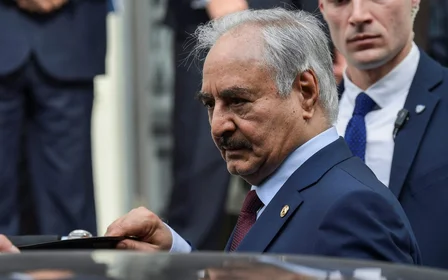
Over the past few years, however, Ankara has re-established ties with eastern Libya’s de facto ruler, Khalifa Haftar, commander of the Libyan Arab Armed Forces (LAAF), and particularly with his son Saddam.
Several sources told Middle East Eye that Libya's eastern parliament’s decision to ratify the deal on the same day as Turkish intelligence chief Ibrahim Kalin’s reported visit to Tripoli was no coincidence.
New MEE newsletter: Jerusalem Dispatch
Sign up to get the latest insights and analysis on Israel-Palestine, alongside Turkey Unpacked and other MEE newsletters
“Kalin established really deep ties with Haftar and made tangible progress in carrying this issue to the finish line,” a Libya-based source familiar with the issue told MEE.
Several regional sources told MEE last year that Greece had put considerable pressure on Haftar not to approve the deal, which would deal a major blow to Greek maritime claims in the region.
Bilgehan Ozturk, a non-resident fellow at the Qatar-based Global Institute for Strategic Research, told MEE that Haftar had been looking to diversify his regional relationships and that Ankara was offering things Greece could not.
“Turkey is a heavyweight in the region that can provide substantial help in the defence industry and investment, and help Haftar gain acceptance from the international community,” he said. “Greece doesn’t have these tools.”
The Libya-based source said Ankara had negotiated for months with Haftar, who earlier this month ousted Aguila Saleh as speaker of Libya’s House of Representatives and replaced him with Al-Salhin Abdelnabi al-Obeidi.
'This is just a beginning... we will see major changes in Libya’s structure of governance'
- Libya-based source
Turkey and other regional countries helped mediate a US-backed agreement that representatives of Libya’s rival political camps approved in Tripoli in August. The agreement could see presidential and legislative elections held within two years.
The source told MEE that Ankara had sought a confidence-building gesture from Haftar’s government to show that Turkey could trust it.
“This is just a beginning,” the source said. “We will see major changes in Libya’s structure of governance.”
The source said an eventual deal in Libya, backed by the Trump administration and its envoy Massad Boulos, could see Abdul Hamid Dbeibeh serve as prime minister and Haftar or one of his sons as president, merging the two rival administrations into a single government.
Ozturk added that Ankara’s deepening relationships with Egypt, Saudi Arabia and other regional actors were pushing Haftar to allow Turkey greater influence.
“They would like to keep their options open,” he said.
'One Libya' policy
The deal follows a visit by Turkey’s Foreign Minister Hakan Fidan to Tripoli and, for the first time, Benghazi in early August. In Benghazi, Fidan met Haftar, his sons Saddam and Belkacem, and parliament speaker Saleh.
Ankara described the trip as part of its “One Libya” policy.
Reacting to Tuesday’s decision, Jalel Harchaoui, a Libya specialist with the Royal United Services Institute, said: “It’s impossible to exaggerate the importance of this event. It’s very strategic, very profound.”
Harchaoui told MEE the deal would mark a “watershed” moment in recent Libyan politics, creating a before and after. He described it as an important step towards bringing the divided country closer to a political solution after years of intermittent fighting and deadlock.
The deal is also a win for Saddam Haftar, who Harchaoui said is “on the ascendancy”.
Harchaoui cautioned that Greece, Cyprus, Israel and the United Arab Emirates were “probably very unhappy at today’s deal”. He said the countries had relied on a divided, frozen conflict in Libya for their own strategic considerations, including efforts to encircle Turkey.
The analyst was also cautiously optimistic about the months ahead, given that the war in Sudan had been partly funded through eastern Libya.
“If my prediction turns out to be true, you’ll see a Saddam more willing to stop supporting the Rapid Support Forces in Sudan,” Harchaoui said of the paramilitary group fighting in Sudan’s bloody civil war.
Middle East Eye delivers independent and unrivalled coverage and analysis of the Middle East, North Africa and beyond. To learn more about republishing this content and the associated fees, please fill out this form. More about MEE can be found here.