Iran war: What has the war done to the cost of humanitarian aid?

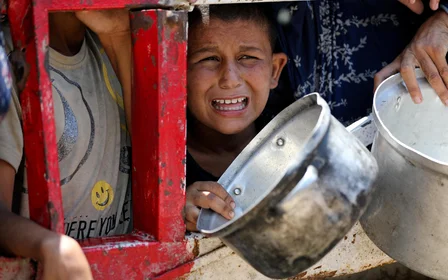
As the UK government warns of potential food shortages owing to the blockade of the Strait of Hormuz, a much more severe risk is being posed to the most vulnerable globally.
The US-Israeli war on Iran has further strained the distribution of humanitarian aid and the international community has been slow to react and support those more directly affected by the war.
Increasing costs involved in transporting aid to where it is needed have been a hidden consequence of the war.
As oil prices balloon, already stretched aid budgets have had the screws tightened on them.
In a new data projection, UK charity Save the Children warned that “every $5 rise in global oil prices triggered by conflict in the Middle East" could wipe out the equivalent of one month of life-saving humanitarian aid for "nearly 40,000 children”.
New MEE newsletter: Jerusalem Dispatch
Sign up to get the latest insights and analysis on Israel-Palestine, alongside Turkey Unpacked and other MEE newsletters
The organisation added that an extra $340,000 a month is now needed to secure shipping of its much needed aid.
A spokesperson for the charity also told Middle East Eye that the delivery of “critical” nutrition supplies from a supplier in New Delhi intended to support 5,000 children and 1,400 pregnant and breastfeeding women in Afghanistan had been held up because of the war.
'Trade over aid'
Since March the cost of air freight transportation for the supplies has rocketed from $240,000 to $435,000 and is now “more than double the value of the supplies” themselves, the charity said.
Save the Children added that “teams are in the process of trying to secure other, more affordable delivery quotes”.
The organisation's global supply chain director Willem Zuidema told Middle East Eye that supplies are “dearly needed” in Afghanistan, where 21.9 million people need humanitarian assistance.
He fears the country may run out of supplies by the end of the month saying it was “a race against the clock”.
Despite being encouraged by the ceasefire, Save the Children emphasised that the effects of the war will be felt for months to come and even in a situation where traffic begins to move, freight carriers have told the charity “oil carriers will likely get the prioritisation”.
The Trump administration has been pushing for a "trade over aid" initiative that would prioritise business opportunities.
Charities have had to get creative under the new constraints.
Zuidema said that medical equipment and supplies destined for Yemen and Sudan have been held up in Dubai, but the charity plans to drive aid to Yemen or move supplies over the border to Jeddah in Saudi Arabia before shipping it to Sudan, the site of the world’s worst humanitarian crisis.
Despite some US assurances that humanitarian aid would be exempt from the US blockade, the ripple effects continue to be felt as food prices rise.
The second shipment of donated medical supplies from the people of India has been dispatched to the Red Crescent Society of the Islamic Republic of Iran. pic.twitter.com/3tH9NzdbBp
— Iran in India (@Iran_in_India) April 11, 2026
In Somalia, where 70 percent of its food is imported or sent as aid, essential commodity prices have increased by at least 20 percent according to the World Food Programme and fertilisers like urea have risen by as much as 70 percent in a few weeks.
This week, countries’ pledges to send 1.3 billion euros ($1.53bn) in aid to Sudan as the war between its government and paramilitaries enters its fourth year were welcomed by many, but global aid efforts are being outpaced by demand.
Even prior to the war on Iran, global aid was thought to have declined by almost a third since 2023, with France, Germany, and the UK all scaling back their commitments.
With the start of the war came an acceleration in need, particularly in Iran where 3.2 million people have been displaced since attacks began.
The first deliveries of aid to the country since 28 February only arrived on Tuesday with aid workers reporting high demand.
Middle East Eye delivers independent and unrivalled coverage and analysis of the Middle East, North Africa and beyond. To learn more about republishing this content and the associated fees, please fill out this form. More about MEE can be found here.