
Yousof Azizi: The Iranian-American scholar pressured by the FBI to return to Iran

Monday 13 April started as a normal day for Yousof Azizi, a PhD student at Virginia Tech University in America.
In the morning, he took his 12-year-old daughter and a four-year-old son to their schools in Baltimore, Maryland, before returning home.
A vocal opponent of the war on Iran, he had been living in the US for nearly 13 years and was recognised as a prominent political commentator on Persian-language media platforms and on his YouTube channel, which has more than 68,000 subscribers.
Azizi had also been involved in discussions with Congress in relation to the Iran nuclear deal during Barack Obama’s presidency.
When he arrived back home that April morning, a number of FBI vehicles were parked outside his residence.
New MEE newsletter: Jerusalem Dispatch
Sign up to get the latest insights and analysis on Israel-Palestine, alongside Turkey Unpacked and other MEE newsletters
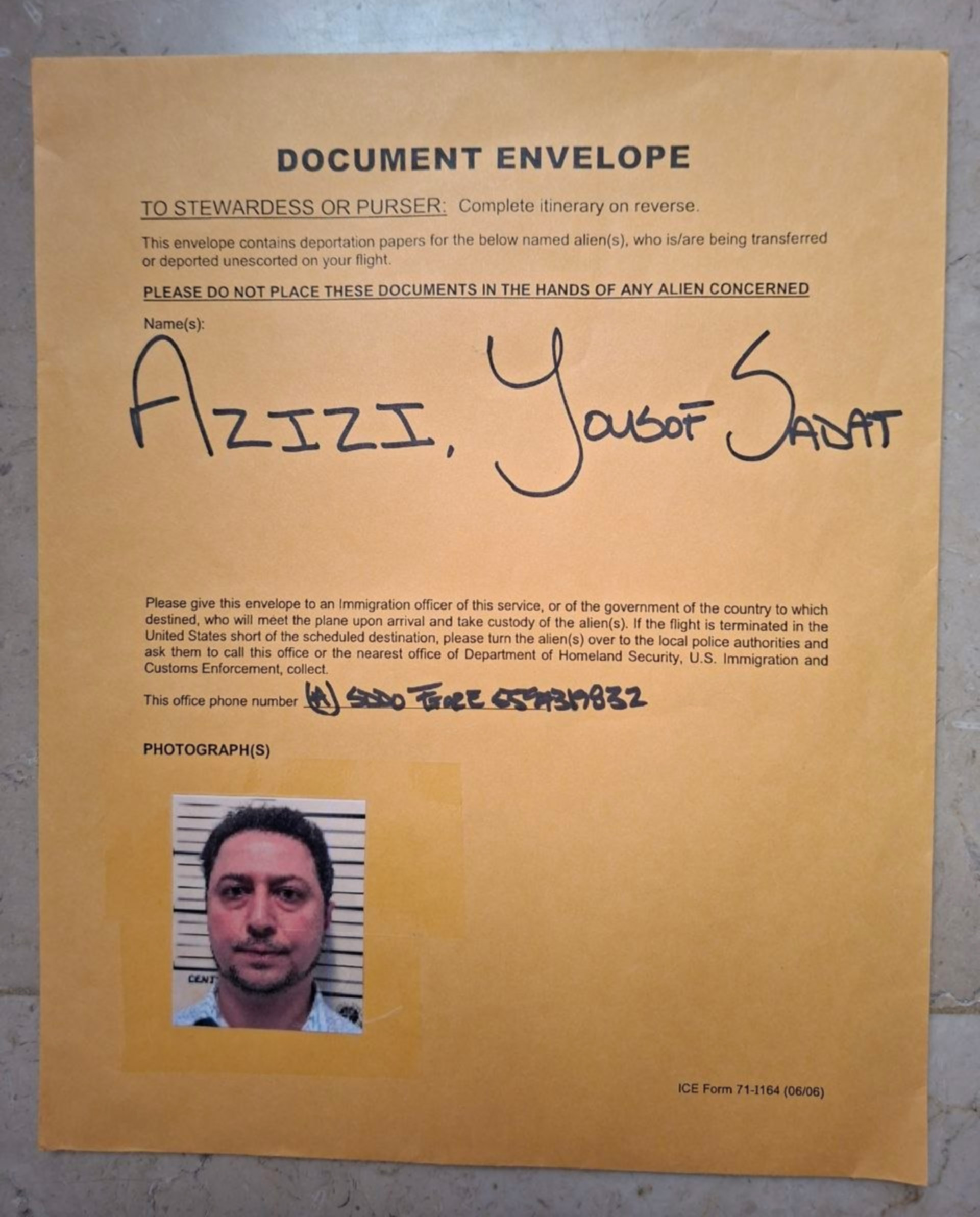
Upon exiting his car, Azizi found himself surrounded by US Immigration and Customs Enforcement (ICE) agents, their rifles pointing straight at him.
Basij claims and visa issues
Azizi was taken to a detention centre in Baltimore.
“The first thing they said to me was that they believed I had been part of the student Basij between 2007 and 2010 when I was studying my master's at Sharif University of Technology in Iran,” Azizi told Middle East Eye.

The Basij is the volunteer paramilitary branch of the Islamic Revolutionary Guards Corps (IRGC) and functions as a local-level enforcement agency, patrolling the streets and ensuring compliance with the country’s Islamic laws.
The US designated Basij a terrorist entity in 2019, and any Iranians who have served in the force and are applying for American visas are required to declare it on their applications.
“I told them I had never been part of the Basij,” Azizi said.
“They said they have multiple sources for this, but during my detention and the court proceedings they never presented any evidence to support their claims.”
Azizi and his wife had never had any issues previously with American authorities.
“The FBI even told the court that I had no criminal record and had never committed any wrongdoing,” he said.
As well as accusing Azizi of being in the Basij, the FBI and Department of Homeland Security also claimed that his student visa status had been terminated after he failed to re-enrol for the fall 2025 semester at Virginia Tech.
He maintained that he had applied for a change in status so that he could study part time, in order to make his university fees more affordable.
Azizi told MEE he had been questioned by the FBI about this two months before his arrest.
“They talked to me for a couple of hours and asked me if my application was rejected would I leave the United States - I said yes,” Aziz said.
He also said the FBI called his wife in March asking similar questions, and that a special agent texted him a few days before his arrest asking to meet with him in another city to answer questions.
“I texted him back asking him to get in touch with my lawyer if he had further questions, because my university advised me that this might be a scam,” Azizi said.
Handcuffed and shackled
During his time in detention, Azizi was moved around various facilities across the country.
He was transferred from the Baltimore ICE facility to Louisiana, then Arizona, before being taken to the California City processing centre.
He said his wife had sought help from NGOs and members of Congress, who told her that he should not have been legally transferred from Baltimore because his spouse and children were there.
Aziz described harsh conditions during his detention, saying: “I was handcuffed, there was a chain around my waist which my arms were attached to, and my ankles were shackled.
“It was physically very painful. I had to sit like that for 13 days,” he added.
“In Arizona we were held for 48 hours in a very cold, small room. There were 20 of us and we were all shaking.
“We had to sleep there with no bedding or pillows and no proper clothes, and had to crawl over each other just to get to the toilet.
“By the time we got to California most people were ill.”
Azizi also said he was denied pain medication for headaches while he was in detention.
'They wanted to get rid of me'
Azizi strongly believes his arrest was politically motivated.
“Some of the questions I was asked during my detention were on the one hand silly but also show they wanted something else from me - for example, they asked me whether Iran was capable of putting mines in the Strait of Hormuz,” he said.

“How could I know this? They have the CIA and surveillance, so they should know.
“They also told me they’d watched my YouTube channel and questioned where the transcripts and data I presented in my videos were coming from. They accused me of getting these through connections in Iran.”
Azizi told the FBI that the data he used in his videos came from his own research and was publicly available, but that they nevertheless insisted it had come from Iran.
He was told that he would be released if he cooperated with the authorities, but said he had nothing to tell them.
During his detention, he recounted, he was visited by the head of the Iranian Interests Section at the Pakistani embassy in the US, who told him the FBI had a list of 25 Iranians they deemed a security risk and wanted to remove from the country - Aziz was one of them.
“I think they needed some information about Iran, and my videos caused the FBI to focus on my case, and they just wanted to get rid of me,” he said.
'I have to focus on my life in Iran'
In June, Azizi decided to request voluntary departure from the US back to Iran.
At his most recent bond hearing, the FBI presented a dossier of allegations, reiterating its previous claims and pointing to a clip of Azizi from a media interview that had been circulated on the IRGC’s Telegram channel.
“I didn’t send the clip to the IRGC. I had many interviews with a variety of news outlets, many of which are actually banned in Iran, but someone in the IRGC picked up one of my clips and shared it,” Azizi explained.
He added that the FBI had characterised him as a flight and national security risk, an accusation he described as baseless.
Azizi had 250 letters of support from university professors across the US, but they ultimately made no difference to his case, even as his lawyer staunchly defended him.
He said that waiting for a final court hearing could have taken up to two years, with no guarantee of a favourable outcome. A deportation order could have ultimately put his future at risk.
On 30 June, Azizi, along with his wife and children, left the US and made his way back to Iran via Turkey.
For now, he plans to complete his dissertation from Iran and currently has no plans to return to the US.
“I have to focus more on my life in Iran, with my parents, who are over 80 years old, and my children, who know our culture here in Iran,” Azizi said.
“I think America wants a single narrative on Iran from the Iranian diaspora and wants to get rid of other voices who are against the war.
“I don’t know if this is motivated by Israel, or by Iranian opposition groups in the United States who have targeted me recently.”
'An act to silence somebody'
The National Iranian American Council (NIAC), a non-profit organisation that advocates for the rights of Iranian-Americans while promoting diplomatic engagement and opposing war between the US and Iran, supported Azizi during his detention.
“Our involvement in these cases is to make sure people have access to the resources necessary for them to protect themselves and to not be exploited because we know of so many cases where it’s a complete black box - nobody can tell what is happening or what their fate is going to be,” NIAC's president, Jamal Abdi, told MEE.
“It seems like in Yousof’s case there was potentially a political dimension to the effort to deport him, more so than what already exists in this highly political environment where Iranians are being targeted by ICE for detainment and deportation.
'America wants a single narrative on Iran from the Iranian diaspora and wants to get rid of other voices who are against the war'
- Yousof Azizi
“It seemed particularly galling that he was detained given the fact he was a prominent commentator, somebody whose research and analysis was featured on television and in print news, and it was hard not to see this as potentially an act to silence somebody whose politics didn't align with the Trump administration.”
Other Iranians living in the US have been similarly targeted by the administration on political grounds.
Hamideh Soleimani Afshar and her daughter Sarinasadat Hoseiny were arrested by ICE on 3 April and remain in custody.
Right-wing media personality Laura Loomer alleged that the women were relatives of former Iranian military general Qassem Soleimani, who was assassinated in a US drone strike in 2020. However, the familial connection remains disputed.
Nevertheless, US Secretary of State Marco Rubio repeated Loomer’s claims and argued that Afshar’s Green Card was revoked because she publicly supports the Iranian government.
“We know other people, university professors for example, who have been detained and in some cases were let go because ICE didn’t have anything on them. But with Yousof it seems like he was detained and then they found something or came up with some pretext that was never proven,” Abdi observed.
“It’s like lawfare where wealthy entities will launch lawsuits, not because they think they can win on the merits but because they think they can bury you in the cost and the resources as it’s not a fair matchup.
“It’s sort of similar if you throw someone in a detention centre that is dirty and they don’t have access to food or a bathroom, are moved around the country with no certainty as to when they will ever get their day in court or if there’s a light at the end of the tunnel. A lot of people will say, ‘Fine, I’ll go back to my country of origin.’ I think that’s what Yousof faced.”
Questions over role of ICE in Israel
A recent investigation by NIAC has revealed that an ICE official based at the US Embassy in Tel Aviv was involved in the deportation of dozens of Iranians in America.
Some of these individuals were vulnerable people seeking asylum because of their political views and religious backgrounds.
'The decision to send those people back was made as the US and Israel were bombing Iran'
- Jamal Abdi, NIAC president
NIAC has published nearly 300 pages of email correspondence between ICE officials that it obtained through Freedom of Information requests, showing that the attache in Israel was working to coordinate deportation flights for Iranians in 2025.
The order to begin deporting Iranians came directly from the White House in June 2025, around the time of the 12-day US-Israeli war on Iran.
According to NIAC’s data, 418 Iranians were detained by ICE between June 2025 and December 2025, with 300 arrested in June and July of that year.
Meanwhile, 125 Iranians were deported to Iran on three flights between the end of September 2025 and January 2026.
Although ICE has an international presence, Abdi believes the extent of this Tel Aviv official’s involvement in Iranian deportations is particularly significant.
“It's a post that has more heft to it than some of the other ICE attaches around the world,” he observed.
“We know that there have been past instances regarding Palestinian deportations where Israel has been involved, but this struck us as worthy of further investigation.”
The situation has raised questions about how susceptible ICE is to pressure from the Israeli government, given the influence of Israeli lobby groups in the US.

Abdi said that Israel has devoted significant resources to targeting the Iranian diaspora through propaganda.
He pointed to campaigns led by former Israeli Intelligence Minister Gila Gamliel that involved using bots and other inauthentic online activity to influence Persian-speaking audiences and promote Israeli policies and positions towards Iran, as reported by Haaretz newspaper.
Abdi told MEE that Americans deserve answers as to why ICE exists in Israel, and whether there is coordination between the US and Israel to target people in the country.
In a statement to MEE, the US Department of Homeland Security (DHS) denied any Israeli involvement in the deportation of Iranians from the US.
"ICE HSI has attaches stationed around the word responsible for administering a variety of law enforcement initiatives, including helping to deter, disrupt, and dismantle transnational criminal and terrorist organizations that pose a threat to the American people," the DHS said.
"The country of Israel does not assist in the deportation of Iranian nationals."
Middle East Eye has contacted the Israeli foreign ministry for comment but received no response by the time of publication.
“We know there’s Israeli influence in our policing, in our surveillance state, and Israel does provide a lot of training and support to law enforcement in the United States,” Abdi said.
According to Abdi, ICE officials had informed US authorities that it would be difficult to organise deportation flights to Iran because the country’s airspace was closed due to the war. Nevertheless, the White House instructed ICE that this was a top priority.
“The decision to send those people back was made as the US and Israel were bombing Iran, and so there was not a disconnect between the fact that we were bombing a country and planning to send vulnerable people back there,” he said.
"This is an administration that is unable to distinguish between a war on Iran versus a war on people who are Iranian, and they have been at war with Iranian people for many years.”
Middle East Eye delivers independent and unrivalled coverage and analysis of the Middle East, North Africa and beyond. To learn more about republishing this content and the associated fees, please fill out this form. More about MEE can be found here.