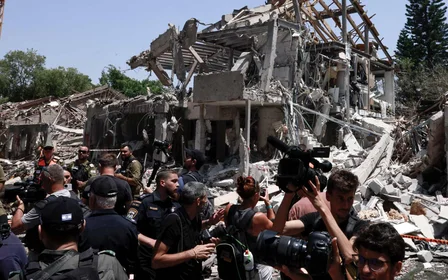
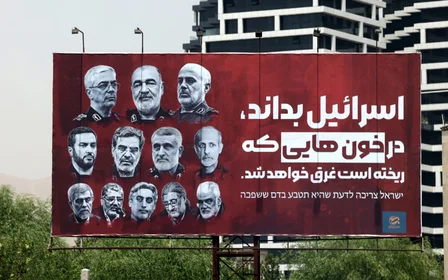
Iranian press review: Outrage as five Kurds handed 12 death sentences

Iran issues death sentences to five Kurds
The issuance of 12 death sentences to five Kurdish citizens has sparked widespread condemnation from human rights activists inside Iran. In response, Iranian activists launched a social media campaign to raise international awareness about the urgent threat facing the condemned individuals.
According to the Kurdistan Human Rights Network, the five prisoners are Ali (Soran) Ghasemi, Pejman Soltani, Kaveh Salehi, Rezgar Beigzadeh Babamiri, and Teyfour Salimi Babamiri.
Soltani had previously been sentenced to death by a Special Juvenile Criminal Court for “complicity in premeditated murder”.
The rights group reported that the latest rulings followed three brief virtual hearings held in recent days. The verdicts were formally delivered to the defendants’ attorneys on Monday.
New MEE newsletter: Jerusalem Dispatch
Sign up to get the latest insights and analysis on Israel-Palestine, alongside Turkey Unpacked and other MEE newsletters
According to the rulings, Ghasemi, Soltani, and Salehi have each been sentenced to three executions on charges including “rebellion”, moharebeh (waging war against God), and “forming a rebellious criminal group”.
Rezgar Beigzadeh Babamiri was handed two death sentences on similar charges. Teyfour Salimi Babamiri - who had previously been released on bail - received one death sentence for alleged participation in a rebellious group.
Iranian opposition complain against German chancellor
A group of Iranian dissidents living in Germany has signed an online petition and filed a complaint with the German Federal Court against Chancellor Friedrich Merz over his recent comments about Israel’s attack on Iran.
The complaint focused on remarks Merz made during the G7 summit in an interview with German broadcaster ZDF, where he praised Israel’s actions and described the attack on Iran as “dirty work” that Israel is doing “for all of us”.
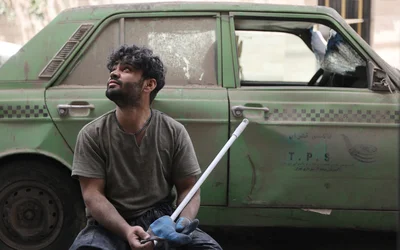
Among the signatories of the petition is artist Parastou Forouhar, a well-known critic of the Iranian establishment.
Forouhar’s parents, both nationalist activists opposed to the Islamic Republic, were stabbed to death in their home in 1998 by Iranian security agents.
Explaining her reason for joining the complaint, Forouhar wrote on Facebook: “[Merz] did not mention the civilian casualties in Iran once during the interview. He didn’t express any sympathy for the difficult situation the Iranian people are going through.”
She also linked the complaint to the growing xenophobia in Germany, pointing to a broader pattern.
“The collective humiliation and hostility toward refugees and migrants, especially those from war-torn countries like Afghanistan, has been rising at an alarming rate,” she wrote.
“The chancellor’s remarks are a warning sign that this attitude may now be extending to the Iranian-German community as well.”
IRGC-linked media call for repeat of 1988 mass executions
Fars News Agency, which is closely tied to Iran’s Islamic Revolutionary Guard Corps (IRGC), has published an article calling for the repeat of the 1988 mass execution of political prisoners.
The article, also republished by other pro-IRGC outlets, including the Hamshahri daily, described the mass killings that took place after the Iran-Iraq war as a “successful experience”.
Under the headline, “Why Repeat the Experience of the Executions of 1988?”, the piece read: “In recent years, efforts have been made to distort and question one of the Islamic Republic’s greatest achievements in fighting terrorism. But it now seems the time has come to repeat that successful historical experience.
“Today, certain traitorous elements, both Iranian and foreign, have caused the deaths of hundreds of Iranian civilians, including women and children.
"These individuals deserve to be executed, as they were in 1988.”
Even before these calls from IRGC-linked media, former political prisoners and human rights organisations had warned that the government might again resort to mass executions in the aftermath of the war with Israel.
War’s toll on civilian mental health
Local media have reported a rise in mental health issues among Iranians following Israel’s attack on Iran, with visits to mental health centres increasing by 40 percent.
According to a report by Rouydad24, not only have some people seen a return of previous mental health problems, but many are experiencing symptoms such as chronic anxiety, insomnia, and post-traumatic stress disorder (PTSD) for the first time.
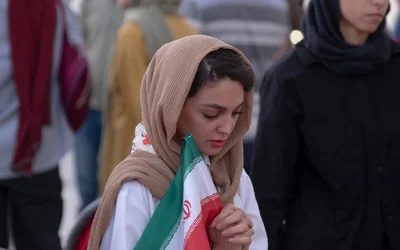
Psychologist Hossein Roozbahani told the outlet, “What we are seeing is widespread anxiety caused by the shock of the crisis and intense environmental stress.”
The report noted that since the start of the Israeli military operation, many people who had previously completed treatment or had their symptoms under control have returned to seek help.
Some have reported experiencing panic attacks, insomnia, and sudden outbursts of anger, while others have developed severe anxiety disorders.
Another group, particularly those who were directly exposed to attacks or explosions, has been diagnosed with PTSD.
The Shargh daily also reported a sharp rise in calls to psychological counselling hotlines, with more than 80,000 calls made in the first 12 days of the conflict.
*Iranian press review is a digest of news reports not independently verified as accurate by Middle East Eye.
Middle East Eye delivers independent and unrivalled coverage and analysis of the Middle East, North Africa and beyond. To learn more about republishing this content and the associated fees, please fill out this form. More about MEE can be found here.