
ICC's Karim Khan says 'senior UK official' threatened him over Israel investigation

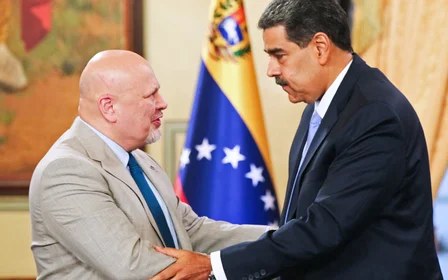
The British chief prosecutor of the International Criminal Court, Karim Khan, has accused a senior British government official of threatening to withdraw the UK's funding and support for the court if he pursued arrest warrants against Israeli leaders.
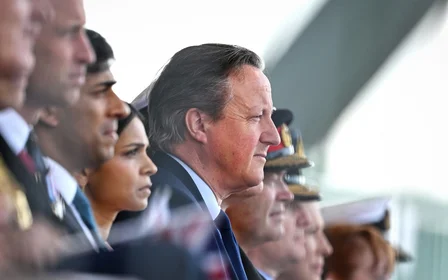
Middle East Eye understands the official to be the then foreign secretary and former prime minister David Cameron.
The allegation is contained in a statement submitted by Khan to the court which describes details of an alleged campaign of threats faced by the prosecutor in the leadup to his office requesting warrants against Israeli Prime Minister Benjamin Netanyahu and former defence minister Yoav Gallant in May 2024 over alleged war crimes in Gaza.
The statement, submitted on Wednesday to the ICC's appeal chamber in response to an Israeli request for Khan to be removed from the investigation and for the warrants to be dropped, appears to corroborate MEE's previous reporting which uncovered many details of efforts to undermine Khan, including Cameron's explosive phone call to the prosecutor.
Israel alleges that Khan rushed the warrants after he was made aware of sexual misconduct allegations against him. But Khan's statement rejects Israel's case, describing it as being based on “a haze of ends-oriented conjecture and misleading or false assertions”, and “a miasma of speculative reporting”.
New MEE newsletter: Jerusalem Dispatch
Sign up to get the latest insights and analysis on Israel-Palestine, alongside Turkey Unpacked and other MEE newsletters
His statement sets out in detail the chronology of events that led his office to apply for warrants against the two Israelis, as well as Hamas leaders, on 20 May 2024, after months of what he described as “a meticulous process” by his office.
Khan has been on leave since May this year, pending the outcome of a sexual misconduct investigation currently run by a UN-led team. He strenously denies the allegations against him.
The allegations of sexual misconduct were first revealed to Khan in person by members of his team on 2 May 2024, the same day he was planning to announce the Netanyahu and Gallant arrest warrants, according to the timeline of events outlined in the document.
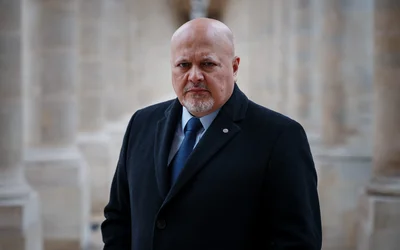
In its request for the prosecutor’s disqualification, made on 17 November, Israel claimed that the prosecutor lacked impartiality and was driven by personal motives to file the warrants hurriedly.
But Khan said that the warrant applications had already been prepared prior to the misconduct allegations, and that his investigation into alleged war crimes by Israel and Hamas began in October 2023, shortly after the Hamas attacks on Israel.
In Khan’s submission, as previously reported by MEE, he explained that by the end of 2023 his investigations had reached a sufficiently advanced stage for him to convene an independent panel of seven legal experts, which included British human rights lawyers Amal Clooney and Helena Kennedy, as well as Israeli jurist Theodor Meron.
The panel was formally established in January 2024 to advise whether the legal threshold for arrest warrants had been met, and specifically whether there were “reasonable grounds to believe” that named individuals had committed crimes within the court’s jurisdiction.
In March 2024, Khan said, the panel had unanimously concluded that his office had gathered sufficient material to request warrants and that the process had been “fair, rigorous and independent”.
On 24 March 2024, Khan travelled to the US, where he briefed senior US officials that he intended to apply for arrest warrants in the Palestine situation and that the applications were expected to be filed by the end of April.
Pressure from officials to abandon warrants
As the preparation of warrants continued, Khan said his office came under increasing diplomatic pressure from a number of states urging him to delay or abandon applications against Israeli officials.
This included a 19 April call from a senior US official warning of “disastrous consequences” if the warrants were pursued, which Khan says he rejected, citing a lack of meaningful cooperation from Israel and no change in its conduct of hostilities in Gaza.
Further pressure followed, including a 23 April phone call to Khan from “a senior UK government official” who warned that arrest warrants against Israeli leaders would be disproportionate and could lead to the UK withdrawing funding from the court.
MEE can confirm, as it has previously reported, that the phone call referenced by Khan was with Cameron.
During the call, according to sources with knowledge of the matter, Cameron told Khan that applying for warrants for Netanyahu and Gallant would be “like dropping a hydrogen bomb”.
Cameron said it was one thing to investigate and prosecute Russia for a “war of aggression” on Ukraine, but quite another to prosecute Israel when it was “defending itself from the attacks of 7 October”.
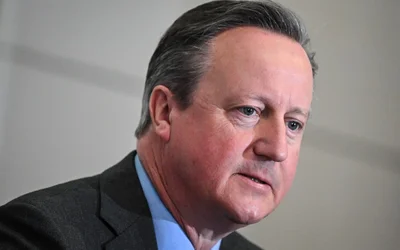
Cameron has not responded to MEE's requests for comment. In an account of the episode in MEE journalist Peter Oborne's book, Complicit: Britain’s Role in the Destruction of Gaza, a source close to Cameron said that the call with Khan did take place and was “robust”.
But the source said that rather than making a threat, Cameron pointed out that strong voices in the Conservative Party would push for defunding of the ICC and withdrawing from the Rome Statute, the founding charter of the ICC.
In June, former Scottish first minister Humza Yousaf told MEE that the UK parliament’s foreign affairs committee should investigate what happened during the phone call.
Yusuf was the Scottish first minister while Cameron was the British foreign secretary.
He said: "Lord Cameron has to be held to account. We are talking about a matter of the utmost seriousness here. We need to know whether a serving British foreign secretary at the time threatened to defund the International Criminal Court."
In August, the independent MP Jeremy Corbyn, a former Labour leader, also called for the British government to investigate what occurred in the phone call between Cameron and Khan.
"I think we need to know, and we have a right to know as well," Corbyn told MEE.
Sanctions on the prosecutor
Following Cameron’s call, Khan listed other attempts to pressure him not to file the applications.
Later in April, 10 US senators wrote to Khan threatening sanctions against him and the ICC if warrants were issued. On 26 April, Netanyahu publicly criticised the ICC on social media, rejecting any attempt to undermine Israel’s right to self-defence.
Khan also described meetings on 30 April and 1 May with representatives of western states and US officials, which he characterises as efforts to persuade him not to proceed. In a 1 May call, US Senator Lindsey Graham warned that pursuing warrants against Israeli officials would trigger US sanctions.
Sanctions on Khan were imposed by the US in February. Other members of his office and a number of court judges have also been targeted.
Khan’s submission on Wednesday challenged Israel’s request as inadmissible due to Israel’s lack of standing, but he said it nonetheless required him to set the record straight on the timeline of events “in the interests of transparency”.
An ad hoc panel of three judges is currently examining the sexual misconduct allegations against Khan, according to a statement by the court's governing body, seen by MEE on Friday. An external UN probe into the allegations has been finalised and its report handed to the judges on Thursday. It is expected that the judges will issue a legal determination on the findings of the UN's fact-finding report within 30 days.
Middle East Eye delivers independent and unrivalled coverage and analysis of the Middle East, North Africa and beyond. To learn more about republishing this content and the associated fees, please fill out this form. More about MEE can be found here.