US needs to move bases from Gulf to Israel, former Centcom commander says

The US needs to relocate its bases in the Gulf to Israel and neighbouring countries to better protect its assets from Iran’s missiles and drones, the former head of US Central Command (Centcom), General Frank McKenzie, said at a webinar last week.
“No one in their right mind would ever put the Centcom forward headquarters, you know, 100 miles away from Iran, [in Qatar], yet that’s where it is,” he told the Jewish Institute for National Security of America, referring to al-Udeid military base.
McKenzie, who was the top military official overseeing US forces in the Middle East from March 2019 to April 2022, said that in 2022, he and other officials told the Biden administration that the constellation of US bases around the UAE, Kuwait, Qatar, and Bahrain was vulnerable to Iranian attacks and US forces should be dispersed to the West, including to Israel.
“We proposed to [the] then Biden administration that we consider moving bases to the West to include Israel, to include Egypt…places we might flush to the West if we get into a fight with Iran,” he said, adding that the Biden administration “aggressively” shut down the idea.
McKenzie said that the current US basing system in the Middle East has become an “artefact”, describing it as a legacy of the Cold War, when the US was concerned about a potential Soviet Union invasion of the oil-rich Arab Gulf states and later, the counter-insurgencies the US waged in Iraq and Afghanistan.
New MEE newsletter: Jerusalem Dispatch
Sign up to get the latest insights and analysis on Israel-Palestine, alongside Turkey Unpacked and other MEE newsletters
“[The US] strategy does not match the reality on the ground,” he added.
McKenzie’s comments echo a June report by Middle East Eye that cited former senior US officials and analysts saying that the US’s basing system would likely need to be restructured, given the vulnerabilities Iran exposed during the war.
Iran effectively forced the US away from the Gulf coast. MEE was the first to report that the US gained access to Taif Air Base in Saudi Arabia in March after Iran pummelled Prince Sultan Air Base, southeast of Riyadh.
Further to the east, US military bases along the Gulf coast were hit hard by Iran.
'Israel is a particularly attractive location'
The Islamic Republic targeted Bahrain, home to the US’s Fifth Fleet; Qatar, home to US Central Command’s headquarters; and air bases in Kuwait and the UAE.
Open-source analysts and some officials have debated the extent to which Iran destroyed US military bases.
McKenzie warned that satellite imagery could be deceiving when assessing whether a damaged base was still operational. He said a base could have several structures destroyed, such as hangars, radar installations, and barracks, but the underground fuelling systems and runways could still be intact, allowing warplanes to land and take off.
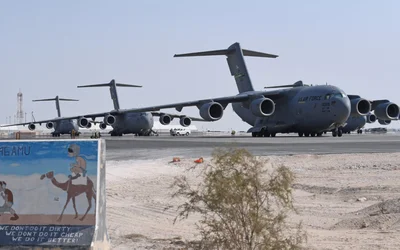
“What we’ve got is a situation where it’s good to be close to your potential enemy because it’s a short commute to the fight,” McKenzie said.
“But it’s bad to be close to your potential enemy, because he has the ability to strike you very quickly.”
McKenzie said he supports maintaining a presence in Gulf states in a show of solidarity with the US’s Arab partners. He said the US could use Gulf facilities to refuel, but switch its long-term presence to countries like Israel, Egypt, and Saudi Arabia’s Red Sea coast.
“We need to look West. We need to look at basing in Israel. I think it’s a great idea,” he said.
McKenzie said Israel is preferable to other countries because it would impose the fewest restrictions on access, basing, and overflight, collectively known as ABO. McKenzie said Israel would also offer superior air defence protection compared to the Gulf states.
The US needs to negotiate ABO with host nations. Gulf states originally prevented the US from using their airspace to attack Iran.
Saudi Arabia and the UAE later joined the US in conducting strikes on Iran and approved the Trump administration’s ABO requests. However, as the war progressed, Saudi Arabia used its veto to prevent new US attacks on Iran, The Wall Street Journal reported.
“Of all the countries, one thing that’s significant is the [host] country…they’re going to want to have a say in where those jets go when they take off,” McKenzie explained.
“Probably Israel is the place where you’re going to have the fewest ABO restrictions on your aeroplanes. That’s why Israel is a particularly attractive location.”
Middle East Eye delivers independent and unrivalled coverage and analysis of the Middle East, North Africa and beyond. To learn more about republishing this content and the associated fees, please fill out this form. More about MEE can be found here.