
The Palestinian-American determined to defend his home from Israeli settlers

Watching anxiously from more than 10,000km away, Louai Abu Ridi could no longer handle being away from his ancestral home.
The Palestinian-American homeowner had been monitoring security-camera footage of Israeli settlers attacking his home in the occupied West Bank town of Qusra, day after day.
The harassment escalated earlier this month, when armed settlers surrounded the house and set up tents outside it, seeking to force the residents out.
“I watched it live when they started to besiege the house and built the tent in front of it,” Abu Ridi told Middle East Eye.
He tried to help from Ohio, urging his brother inside the house to call the police while appealing to US officials and lawmakers.
New MEE newsletter: Jerusalem Dispatch
Sign up to get the latest insights and analysis on Israel-Palestine, alongside Turkey Unpacked and other MEE newsletters
But when nothing changed, he booked a flight to Qusra, where he grew up and built his dream home.
“I told my brother, ‘You know what, I’m tired. I can’t sleep, watching those security cameras live. I’m gonna book my flight. I will come to support you. I will be with you in the same house. I will do whatever it takes to provide you food and end the siege’.”
Now inside the besieged house himself, Abu Ridi says he is determined to protect it and prevent settlers from taking it over.
He spoke to Middle East Eye about the attacks, the lack of meaningful action from US officials and his determination to remain in the house.
‘That dream became a nightmare’
For Abu Ridi, the house is more than bricks and concrete.
Qusra, southeast of Nablus, is where he was born and went to school. His mother, siblings, cousins and friends still live there.
“I have a lot of emotion attached to the village,” he said. Although he works and lives in Ohio with his wife and two daughters, aged 10 and 19, Abu Ridi visits Qusra once, twice or even three times a year.
“I decided to build my dream house, my vacation house, in Qusra, so my wife and kids could come visit with me and enjoy it,” he said. “But that dream became a nightmare for us.”
The nightmare began in January, nearly three years after he started building the house.
Settlers began repeatedly attacking the property and harassing Abu Ridi’s brother, who was staying there.
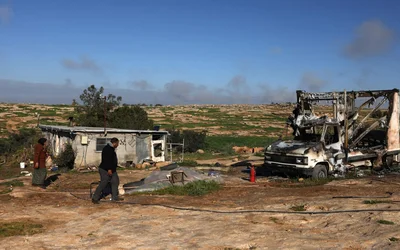
“I witnessed all the attacks,” he said, recalling the incidents through his security-camera footage.
In May, he watched as about 15 settlers threw rocks at his brother while he was inside the house.
Then, on 9 August, Abu Ridi noticed something different.
Settlers brought tents and set up camp around the property, preventing people from entering or leaving. The scene immediately alarmed him.
Only weeks earlier, settlers had surrounded a house belonging to the al-Tubasi family in the nearby town of Jalud.
The family was left under siege after electricity and water were cut off and roads leading to the house were blocked. After five days, settlers stormed the property and forced the residents out at gunpoint. The house has since been taken over by settlers, who have raised an Israeli flag on the roof.
Settler attacks on Palestinians, including the forced removal of people from their homes, have risen sharply since October 2023. More than 6,000 Palestinians have been forcibly displaced in the occupied West Bank because of settler attacks since January 2023, according to UN data.
‘They sided with the settlers’
Fearing his house would be next, Abu Ridi sprang into action.
First, he told his brother to call the police. Days later, after the siege drew international media attention and condemnation, the Israeli army arrived in Qusra. The army said it was beginning an operation to remove the settlers and prevent clashes between them and Palestinians.
But Abu Ridi says the reality on the ground was very different.
“When the army was dispatched, they sided with the settlers,” he said. “They went to their tent, conducted prayers with them and celebrated.”
The army also declared Qusra a closed military zone, banning non-residents from entering.
'It is a nightmare. We can’t sleep at night. We have to keep watch'
- Louai Abu Ridi, Palestinian homeowner
Rather than removing the settlers, Abu Ridi says soldiers have effectively helped maintain the siege, restricting people from entering and leaving freely, including those trying to deliver food to families inside.
“It’s insane. There are only 10 to 15 settlers. If the army really wants to get rid of them, simply arrest them, take them out of the area, and the problem is solved,” he said.
“They say on the news they send the IDF [Israeli army] to protect the residents and remove the Israeli settlers, but that’s not what’s happening on the ground.”
Abu Ridi also contacted the US embassy in Jerusalem and the office of his representative in Ohio, Congresswoman Marcy Kaptur. “I told them, ‘I’m a US citizen, my house is under siege. I need help’.”
He said both the embassy and Kaptur’s office responded and have been helpful. But beyond public condemnation of the settlers, he said, little has changed.
“I know [US ambassador to Israel] Mike Huckabee condemned the settlers and called them terrorists. And I appreciate this. That’s a good move,” Abu Ridi said. “However, none of that helped me on the ground. I’m still under siege for two weeks now.”
‘I had no choice’
Watching his family - including his sister, brother, nephew and 83-year-old mother - face the army and settlers without him became unbearable. On 17 August, Abu Ridi flew to Qusra to join them. The decision was not taken lightly.
“It was difficult for my wife and my two girls, who I had to leave back in Ohio,” he said. “It was a terrifying moment for them, not knowing what I was going into. But I had no choice. I had to be here with my brother, my mother and my sister.”
His 10-year-old daughter continues to message him to check on him, sometimes well past midnight in Ohio, hours after her bedtime.
“She keeps asking me, ‘Am I going to sleep in the same house? Are the settlers going to attack you? Are you gonna come back for us? Are you gonna be safe?’”
Abu Ridi tries to reassure his family. But he cannot hide the fear he feels inside the house.
“It is a nightmare. We can’t sleep at night. We have to keep watch,” he said. “Are they gonna come attack us? This is what’s been going on for months now. Someone has to stay up all night watching around the house and taking turns.”
‘I’m not leaving this house’
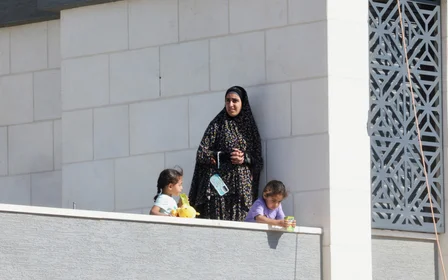
Abu Ridi has also sheltered another family whose home next door was besieged by settlers and whose members were forced out by soldiers.
The family - a couple with two daughters, aged two and four - now live away from their home.
“They are terrified and scared. They keep looking at their own house, asking for their toys, asking to go back to their house, not knowing what’s going on,” Abu Ridi said. “It is a mixed emotion. You know, it’s sad, devastating, terrifying, all of the above.”
Despite the danger and the possibility of another surprise settler raid, Abu Ridi says he is prepared to stay.
“I’m not leaving this house until I make sure it’s safe and won’t be stolen by settlers.”
Middle East Eye delivers independent and unrivalled coverage and analysis of the Middle East, North Africa and beyond. To learn more about republishing this content and the associated fees, please fill out this form. More about MEE can be found here.