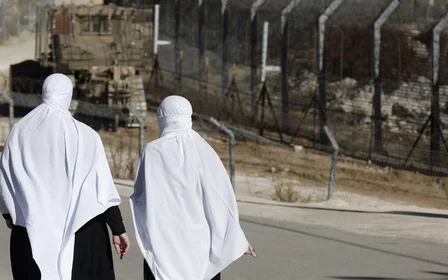
Hikmat al-Hijri is attempting to recast the Druze story through a Zionist lens


Hikmat al-Hijri, the spiritual leader of the Druze community in Syria’s Sweida governorate, made a remarkable statement this week.
The Druze, he declared, are “an inseparable part” of the state of Israel, “even in terms of faith”.
These comments should not be dismissed as just another provocative declaration by a religious leader opposing the government in Damascus. They reveal something much deeper: the emergence in Sweida of a narrative strikingly similar to the one cultivated for decades by Zionist political discourse.
This narrative advocates the separation of the Druze from their Arab and Islamic environment, and their relocation - both politically and historically - into an Israeli Zionist framework.
This is not about Hijri seeking Israel’s support. His relationship with Israel has been developing for years.
New MEE newsletter: Jerusalem Dispatch
Sign up to get the latest insights and analysis on Israel-Palestine, alongside Turkey Unpacked and other MEE newsletters
Since the fall of the Assad regime in December 2024, Hijri has increasingly presented Israel as a natural political partner, then as a potential guarantor of his community’s future, and now as a spiritual and ideological aspiration for the Druze.
The July 2025 massacre in Sweida contributed to a political environment in which an Israeli role could be presented as necessary or legitimate. But Hijri has now taken the next ideological step, recasting a contested political relationship as a supposedly ancient historical and religious union, thus replicating the Zionist narrative.
Political function
What is far more consequential is the language he uses. There is an enormous difference between saying that the Druze of Sweida have interests in common with Israel, and claiming that the two are partners in faith.
The former is politics. The latter is building an identity, after ensuring the destruction of a pre-existing identity. This is precisely where the Zionist project has historically operated with regards to the Druze.
The Israeli state did not simply seek an alliance with the Druze after 1948. It developed institutions and narratives that worked to distinguish the Druze from the broader identity of Palestinian Arabs in Israel.
Separate educational structures, political categorisation and military integration helped to institutionalise the idea that the Druze were fundamentally different from the surrounding Palestinian Arab population.
The Druze must refuse being 'melted' into Zionism. They should be able to say, clearly and without qualification: our faith is ours, our history is ours
Israel justified this separation by portraying the Druze as a distinct people with ancient connections to the Jewish people, linking them to the “lost tribes” of Israel, and aiming to construct a special relationship between Moses and Jethro, or Nabi Shu’ayb, the Druze prophet. This narrative has further advocated the notion of Druze loyalty to the rulers of the territory in which they live.
Whether such stories are religious interpretations, historical myths or political constructions is beside the point. Their political function has been to produce a particular answer to the question of where the Druze belong. Increasingly, the answer has been: not as part of the Arab world.
This ideological framework is what makes Hijri’s recent statements so striking and dangerous. For centuries, Druze communities across the Levant - in Syria, Lebanon, Palestine and Jordan - have been inseparable from the societies in which they have lived.
In Syria, the Druze are not an imported or foreign community. They are part of the country’s social and political history. The Great Syrian Revolt of 1925, led by Sultan al-Atrash, remains one of the clearest symbols of Druze participation in the struggle against French colonialism and in the formation of modern Syria.
Hijri’s rhetoric, however, points in the opposite direction. It no longer merely demands political autonomy from Damascus. It increasingly presents the Druze as belonging to a different historical and ideological space - one that culminates in Israel. The past is thus being rewritten to justify the politics of the present.
Strategic objectives
The July 2025 Sweida massacre is central to understanding the political environment in which this rhetoric has flourished - but it should not be reduced to a simple story of Israel “saving” the Druze.
Israel presented its military intervention as required to protect the Druze, while critics interpreted it as serving broader Israeli strategic objectives in southern Syria. Analysts have also highlighted Israel’s efforts to weaken Syria and prevent the consolidation of state authority in the south.
At the same time, Hijri’s role in the escalation remains deeply contested. What is beyond dispute is that he emerged from the July 2025 massacre with considerably greater political and military influence, creating space for his ideological project to advance.
The question is no longer why Hijri sees Israel as an ally. It is why he increasingly wants the Druze to understand themselves through Israel only.
If the Druze are told that their history is fundamentally tied to Israel, that the two sides share a special bond of faith, and that their political future lies outside the Syrian framework, then the result is not closer relations with Israel. It is the Zionisation of the Druze in Syria.
The responsibility to correct that path extends beyond those outside the Druze community who bear responsibility for the July 2025 massacre. Druze religious figures, intellectuals and community leaders across Syria, Lebanon, Palestine and Jordan should confront these claims.
They must refuse the idea that being Druze requires a political, historical or religious identification with Israel. They must refuse the reduction of their centuries-old history to a narrative written through the interests of a modern state accused of genocide.
The danger is not political dependence on Israel. It is assimilation into a political project that seeks to redefine the Druze according to its own interests; to separate them from their Arab surroundings and Levantine history; and ultimately to make their relationship with Israel appear natural, inevitable and ancient.
The Druze must refuse being “melted” into Zionism. They should be able to say, clearly and without qualification: our faith is ours, our history is ours, and our political future cannot be dictated by a narrative that asks us to abandon the societies and peoples with whom we have shared this land for centuries.
Hijri might believe he is securing a future for Sweida. But by adopting a narrative that separates the Druze from their history, he risks doing something far more dangerous.
The views expressed in this article belong to the author and do not necessarily reflect the editorial policy of Middle East Eye.
Middle East Eye delivers independent and unrivalled coverage and analysis of the Middle East, North Africa and beyond. To learn more about republishing this content and the associated fees, please fill out this form. More about MEE can be found here.