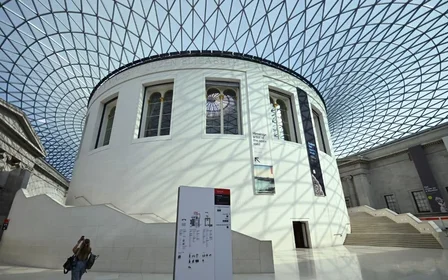
British Museum faces scrutiny over sponsor’s links to illegal Israel settlement

The British Museum is facing questions about its due diligence processes over links between the sponsor of its landmark Bayeux Tapestry exhibition, Igor Tulchinsky, and a project he is reported to have funded in an illegal Israeli settlement in the West Bank.
Internal emails seen by Middle East Eye reveal that the museum appears to have been courting Tulchinsky even while he was visiting the settlement last November.
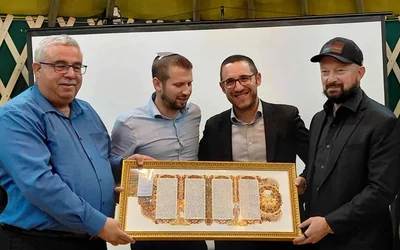
Tulchinsky, the billionaire founder of US investment firm WorldQuant, was in Efrat, part of the Gush Etzion bloc of settlements southeast of Jerusalem, on 13 November to open a “therapy yurt” which he is reported to have dedicated to “Israel’s heroes”.
The visit took place just two weeks after museum chair George Osborne had given the green light for sponsorship negotiations to proceed after being told that due diligence checks into Tulchinsky had raised “no concerns”.
Within another two weeks the deal had been sealed in principle, with the museum’s director of development writing to Osborne to inform him that Tulchinsky had agreed to the sponsorship.
New MEE newsletter: Jerusalem Dispatch
Sign up to get the latest insights and analysis on Israel-Palestine, alongside Turkey Unpacked and other MEE newsletters
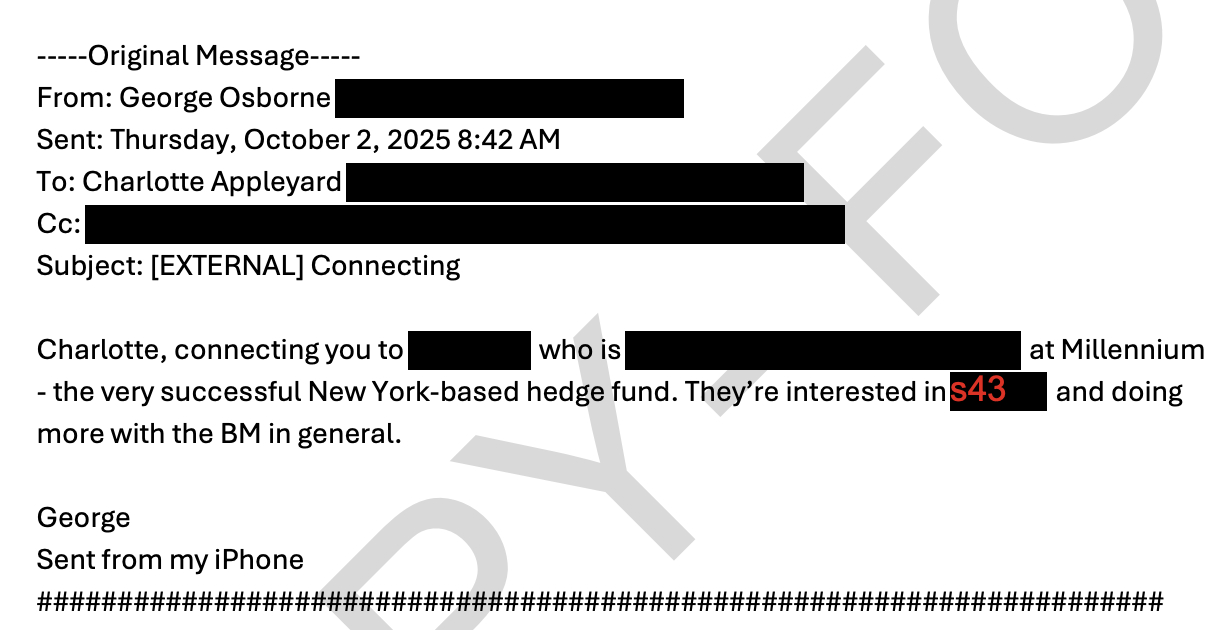
The emails also reveal that Osborne appears to have facilitated the museum’s initial approach via a Tulchinsky-linked New York hedge fund, Millennium Management, at the beginning of October 2025.
The emails were released by the museum, a public institution that is independent of government but regulated by the Department for Digital, Culture, Media and Sport (DCMS), in response to a freedom of information request by campaign group Culture Unstained.
Much of their content is redacted, including some details of the research carried out on Tulchinsky as part of the museum’s due diligence process.
But the disclosures shed new light on the chain of events which led to the sponsorship deal – reportedly worth £5m – being signed and publicly announced in February.
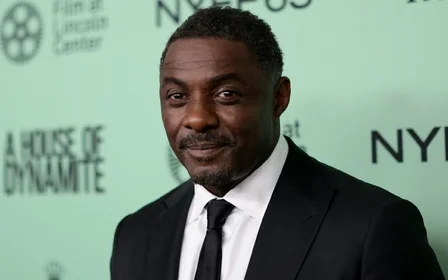
Tulchinsky has featured prominently in the museum’s promotion of the Bayeux Tapestry exhibition, which has brought the epic embroidery telling the story of the 11th-century Norman invasion of England to London for the first time.
He attended last month’s opening ceremony alongside King Charles, French President Emmanuel Macron and British Prime Minister Andy Burnham.
Renewed scrutiny
The museum has opened a new Igor Tulchinsky Room for members, while a newly commissioned portrait of Tulchinsky has been hung in the museum for the duration of the exhibition.
On Saturday, Tulchinsky is due to host the museum’s annual fundraising ball “in recognition of his support for the Bayeux Tapestry”, an event set to be attended by a stellar guestlist of dignitaries and celebrities.
Guests at last year’s event included Lisa Nandy, the culture secretary, and London Mayor Sadiq Khan.
But revelations about Tulchinsky’s funding for the “therapy yurt” in Efrat, as well as a tougher stance on settlements from the UK government, has brought renewed scrutiny of his ties to the museum.
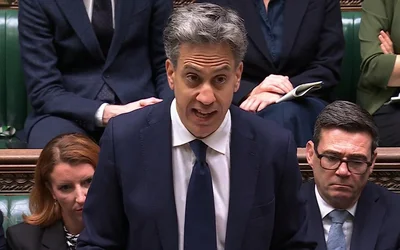
Foreign Secretary Ed Miliband announced plans last month to impose new sanctions against companies and individuals who support settlement expansion.
He also declared that the government now accepted an International Court of Justice ruling that Israel’s entire occupation of the West Bank and East Jerusalem is illegal.
“With UK sanctions on trade with illegal settlements in the West Bank, the museum must urgently review Tulchinsky's ties and act accordingly,” said a spokesperson for Culture Unstained.
The deal may also put the museum in potential breach of the Museums Association’s Code of Ethics, the spokesperson said.
Neil Sammonds, a spokesperson for the International Centre of Justice for Palestinians (ICJP), urged the DCMS to “address these concerns as quickly as possible”.
Sammonds also called for “a ban on British institutions receiving donations from individuals and entities providing aid and assistance in illegal settlements”.
In earlier comments to MEE, Zack Polanski, leader of the Green Party, called for an investigation into the deal.
Anna Sabine, the Liberal Democrats’ culture spokesperson, raised the matter in parliament, asking Nandy whether the government had assessed if Tulchinsky’s sponsorship was consistent with the government’s new sanctions regime.
In a written answer published on Tuesday, DCMS minister Ian Murray said: “The Secretary of State has made no such assessment as national museums are operationally independent from the government, with decisions about commercial and philanthropic donations taken by their trustees. All national museums sponsored by DCMS operate within a mixed funding model, combining public funding with self-generated income.”
Murray cited a donations and sponsorship policy which appears to have been adopted by the museum’s board of trustees in July 2026.
“Government’s policy is that the consideration of these matters remains the responsibility of the bodies concerned, and there are no plans to alter this,” he said.
The British Museum declined to comment to MEE.
The DCMS declined to comment, but a spokesperson told MEE that no ministers are due to attend Saturday’s ball.
WorldQuant and Millennium Management did not respond to requests for comment.
‘Happy to proceed’
The emails seen by MEE suggest that much of the legwork the museum did to secure the Tulchinsky deal took place in October and November last year, and was prompted by an intervention by Osborne himself.
On 2 October, Osborne, who chairs the board of trustees, sent an email connecting Charlotte Appleyard, the museum’s development director, with a contact at Millennium Management.
Osborne’s email appears to convey Millennium’s interest in a project or opportunity related to the museum that is redacted, as well as “doing more with the BM in general”.
Tulchinsky worked for Millennium for 12 years before launching WorldQuant in 2007 and the companies have many overlapping connections.
WorldQuant is reported to manage approximately $9bn on behalf of Millennium, and the two companies share the same chief communications officer.
Four weeks later, on 30 October, Appleyard sent an email to Osborne summarising the museum research team’s due diligence findings on Millennium and Tulchinsky, which were also attached with documents marked “Chair Approval DD Checklist”.
Appleyard reported “moderate concerns” about Millennium, but described these as “commensurate with the size of the organisation as well as being in the financial sector”.
She said there were “no concerns” about Tulchinsky and asked Osborne to look at the material as soon as possible so she could “proceed freely”.
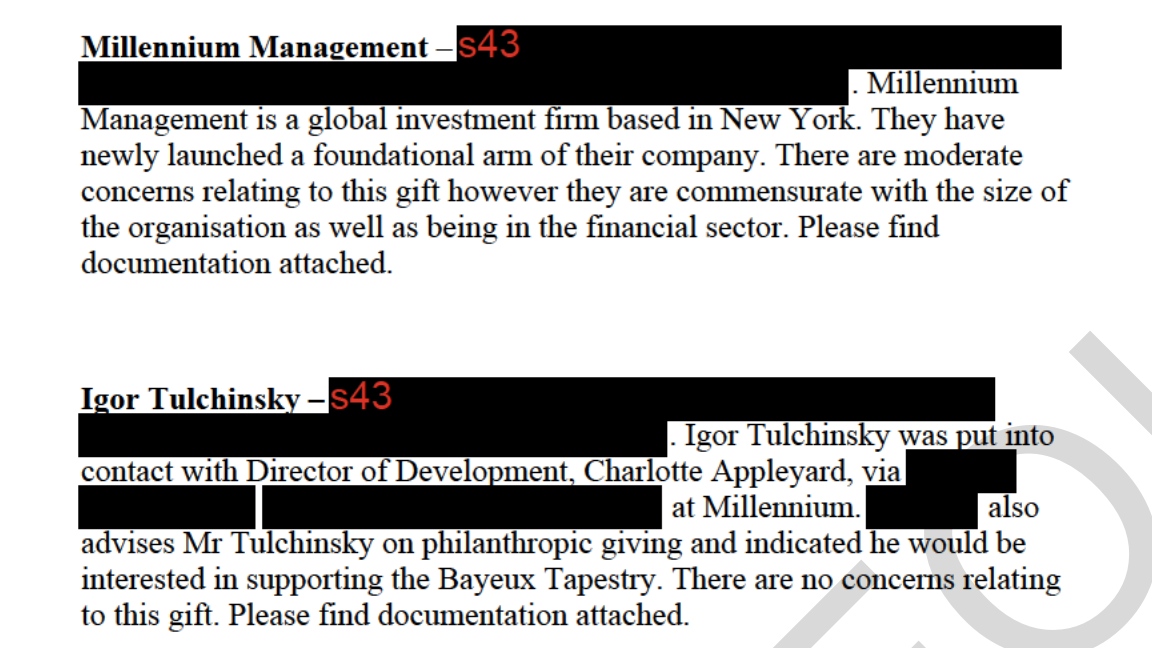
The museum’s research document on Tulchinsky includes a partially redacted section titled “Key Due Diligence Flags”, in which what appear to be several lines of text are hidden from view.
Enquiries into Tulchinsky included searches in a risk and compliance business database and a news archive. Neither produced any results.
Tulchinsky’s source of income is listed as “hedge fund”. A section on past controversies is marked “NA”, which usually means “not applicable”.
The document includes details of Tulchinsky’s philanthropic work, and describes him as “committed to making higher-quality education more available worldwide”.
A short section titled “Interests” is entirely redacted under an exemption of the Freedom of Information Act which covers commercial interests and trade secrets.
Just 80 minutes after receiving Appleyard’s email, Osborne replied: “Yes – happy to proceed.”
‘Inner Iron Dome’
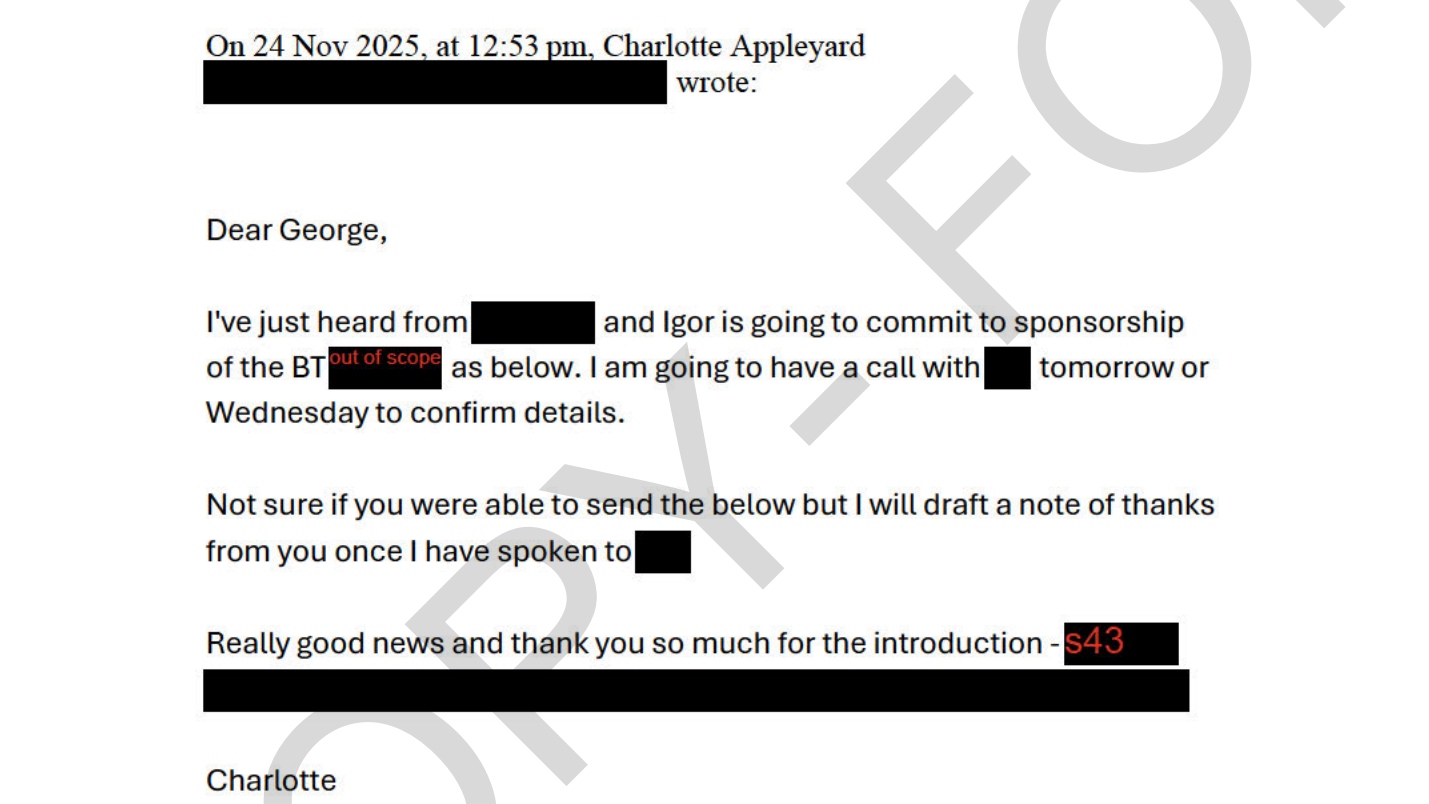
According to the emails, Appleyard was next in touch with Osborne on 24 November 2025, when she first reported that “conversations have progressed very quickly” since his introduction to Millennium, and, later the same day, that Tulchinsky “is going to commit to sponsorship of the BT”.
In the interim period, Tulchinsky had reportedly spent time in Israel, as well as visiting Efrat on occupied Palestinian land on 13 November, to attend the opening of the therapy yurt.
'[The agreement] anticipates that the British Museum will continue to monitor the sponsor's activities'
– Jolyon Maugham, Good Law Project
Efrat is considered the capital of Gush Etzion, a collection of settlements that is expanding towards Bethlehem and threatens to cut the West Bank in half.
In a speech, Tulchinsky is reported to have paid tribute to “Israel’s brave warriors and their families”, and described the yurt as “Israel’s inner Iron Dome”.
Tulchinsky is an avowed supporter of Israel and has extensive business interests in the country.
In an interview in March, Tulchinsky told the Jerusalem Post newspaper he had provided financial support to the Israeli army following the 7 October 2023 Hamas attacks and the start of Israel’s war in Gaza.
Earlier this year, he launched a Tel Aviv-based defence tech-focused venture capital fund, which is headed by a recently retired Israeli army commander who has promoted the use of remote-controlled vehicles linked by a human rights monitor to alleged war crimes in Gaza.
There is no suggestion that the British Museum was aware of Tulchinsky’s visit to Efrat or his reported funding of the therapy yurt at the time it was negotiating the sponsorship deal with him through Millennium.
But Jolyon Maugham, the director of the Good Law Project, said the emails seen by MEE appeared to raise questions for the museum about the rigour of the due diligence process that preceded the deal.
Maugham said the terms of the sponsorship agreement, which was also released in response to Culture Unstained’s FOI request, appeared to require the museum to review the arrangement if new information risked causing it reputational damage.
The contract states that omission or future acts that carry a significant negative impact on the museum’s image or reputation are grounds to terminate the agreement.
“[The agreement] anticipates that the British Museum will continue to monitor the sponsor's activities and check that those activities are, to put it broadly, not damaging to the British Museum's reputation,” Maugham said.
“Obviously, in practice, it is easier to refuse to take the money than to give it back once you have taken it.”
Middle East Eye delivers independent and unrivalled coverage and analysis of the Middle East, North Africa and beyond. To learn more about republishing this content and the associated fees, please fill out this form. More about MEE can be found here.