The execution of two Bangladeshis in Saudi Arabia explained

Clutching a picture of his daughter, Fazal Mia is still in shock that he was not told that his child, Suety Akhter, would be executed in Saudi Arabia.
After leaving Bangladesh to work in the Gulf kingdom, Akhter sent money home for the first five months before calling her family one day to say she had been imprisoned.
The family then found out from news reports that their daughter was handed the death penalty, alongside another Bangladeshi citizen, Nazrul Islam Abdul Basir.
The news of the two executions came after Sri Lanka had successfully intervened to overturn a death sentence for one of its own citizens in Saudi Arabia after they were found guilty of insulting the Prophet Muhammad.
This has raised difficult questions about why Dhaka was not informed of the death sentences and how much – or how little – Bangladesh is willing to do to protect its vulnerable overseas workforce.
New MEE newsletter: Jerusalem Dispatch
Sign up to get the latest insights and analysis on Israel-Palestine, alongside Turkey Unpacked and other MEE newsletters
How did we get here?
On 14 October, Saudi Arabia executed Akhtar and Abdul Basir in Mecca.
Abdul Basir, aged 22, was the eldest of four siblings and hailed from the Bangladeshi city of Brahmanbaria.
Akhter, whose age has not been made public, came from the Bangladeshi city of Tangail and was the youngest of four daughters. She left behind a four-year-old daughter.
Abdul Basir and Akhter both worked for Al-Majal company in Saudi Arabia as cleaners.
The Saudi Ministry of Interior confirmed the execution in a press statement to the Saudi Press Agency.
The statement, published only in Arabic, claimed the two Bangladeshi nationals had committed an “indecent” act inside a mosque without stating the act.
The interior ministry said the death sentences were handed down as ta’zir – discretionary punishments under Islamic jurisprudence – followed by judicial review and a royal order.
What crimes were they accused of?
The Saudi authorities did not publicly share specific details of the alleged crimes, the location of the mosque where they were committed, the dates of arrest, or whether the defendants had access to qualified legal counsel and interpreters during trial proceedings.
But a confidential diplomatic memo leaked to the Bangladeshi Daily Star newspaper revealed that they were arrested separately and charged on different counts.
A prisoner list that the consulate in Jeddah received on 30 September showed that Abdul Basir was detained on 1 August 2023, under Saudi Arabia's cybercrime law.
Akhter was detained the following day on allegations of adultery. Her father said Akhter told them that other workers had “framed” her after she had an argument with co-workers. The family then lost contact with Akhter for nearly a year.
Both had been imprisoned for three years before Saudi Arabia executed them. The prisoner list made no mention of the death penalty at the time.
The consular memo, however, does not explain how the September allegations relate to the offences for which the two were executed.
Why is Bangladesh facing criticism?
The Bangladeshi government stated that it only learned of the executions after they took place.
But the confidential memo given to the Daily Star indicates that the Bangladesh Consulate General in Jeddah had received a list of 97 Bangladeshi prisoners in Saudi Arabia.
Criticism mounted further after Bangladesh’s state minister for foreign affairs, Shama Obaed Islam, publicly remarked that citizens must abide by foreign laws and that “when a law is violated there is not much I can do for a Bangladeshi citizen”.
Rights advocates and analysts have raised several key concerns regarding Dhaka's response:
- Lack of proactive engagement: Bangladeshi officials did not request court records, clarify the charges, or provide legal representation for the accused while they were detained.
- Consular obligations: While Article 36 of the Vienna Convention on Consular Relations requires host countries to inform detained foreign nationals of their rights, origin countries are expected to maintain systematic monitoring for citizens facing severe criminal charges.
The contrast: Sri Lanka’s diplomatic push
The Saudi executions coincided with the case of Anojan Sivarasa, a Sri Lankan worker who was likewise sentenced to death in Saudi Arabia over a Facebook post deemed blasphemous.
Unlike Bangladesh, Sri Lanka launched a coordinated diplomatic and legal effort. The Sri Lankan foreign ministry first publicly confirmed its diplomatic engagement shortly after the death sentence was handed down in September.
Sri Lanka then sent its ambassador to Saudi Arabia, where he visited Sivarasa in prison to coordinate support. Colombo then sent a specialised legal team to handle the appeal.
On 13 October – just one day before the two Bangladeshis were executed – Saudi Arabia’s Supreme Court overturned Sivarasa’s death sentence.
The broader picture
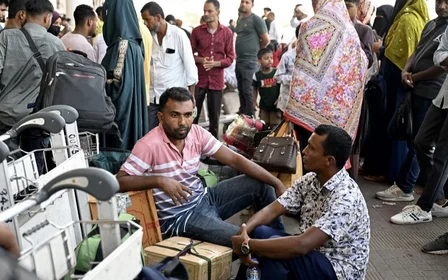
Saudi Arabia is home to over three million Bangladeshi nationals, making the kingdom a crucial pillar of Bangladesh's foreign remittance economy and largest source of workers for the South Asian country.
World Bank and IMF data show that remittances account for roughly 7.4 percent of Bangladesh's overall gross domestic product.
The outcome of these cases highlights the steep challenges foreign migrant workers face within the Gulf judicial systems, and underscores the critical role that active consular intervention plays in defending their rights abroad.
Middle East Eye delivers independent and unrivalled coverage and analysis of the Middle East, North Africa and beyond. To learn more about republishing this content and the associated fees, please fill out this form. More about MEE can be found here.