For Palestinians, Israeli election will only determine the pace of dispossession


Israel’s general election on 27 October is widely being framed as a referendum on Prime Minister Benjamin Netanyahu. Polls suggest that neither Netanyahu’s bloc, nor the opposition bloc of four Jewish-led parties, will win a majority in the Knesset, Israel’s parliament.
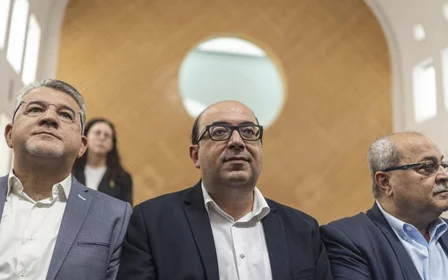
Arab parties, representing 20 percent of the citizenry, remain outside the arithmetic of government. Their exclusion reveals much about the political terms on which this election is being fought.
Across history, the settler-colonial democracies that most thoroughly dispossessed indigenous peoples - the United States, Canada and Australia - have held elections that advanced this process. Because elimination and land seizures underpinned their existence, they never put these issues on the ballot; voters chose only who would do it most effectively and rapidly.
Similarly, Israelis are not choosing a direction in the coming election. They never have. They are choosing the pace of ethnic cleansing, genocide and dispossession of the Palestinian people.
Indeed, Israel’s election campaign follows a familiar settler-colonial pattern. Voters are being asked to judge Netanyahu on wars, security, the ultra-Orthodox draft, the judicial overhaul, and other domestic issues. Yet on the questions that decide Palestinian lives, Netanyahu’s bloc and the opposition offer different routes to the same destination. They may differ in intensity, pace and timing, but not in direction.
New MEE newsletter: Jerusalem Dispatch
Sign up to get the latest insights and analysis on Israel-Palestine, alongside Turkey Unpacked and other MEE newsletters
This shared direction is forcefully reflected in the abandonment of the rhetoric of peace, negotiations and two states, which once served as a facade to conceal Israeli settler-colonialism. Dispossession is now pursued in the daylight, across the left-right divide.
Consider Yair Golan, leader of the leftist Democrats, who dismisses the two-state solution as a “galactic leap”.
His alternative involves more of the same Israeli settler-colonial policies: “security coordination” with the Palestinian Authority, support for its “moderate” and “effective” administrative authority, and “civil separation” between Palestinians and Israelis. Separation without equality is a euphemism for apartheid.
Stealing land
In settler-colonial democracies across history, infrastructure has fuelled land expropriation and won votes.
Israel has developed a similar network of legal and material infrastructure to dispossess Palestinians. The Absentees’ Property Law of 1950 has been used to transfer property rights from Palestinians forced out in 1948 to Jewish settlers and infrastructure projects.
For decades, successive Israeli governments have classified extensive tracts of the occupied West Bank as “state land”, paving the way for colony construction and expansion.
What is at stake today is no longer simply the scope of discrimination. It is the political neutralisation of an entire constituency
Jewish-only roads, settler outposts, the apartheid wall, military zones, and projects to Judaise land in the West Bank, the Galilee and the Negev (Naqab) have been designed to displace Palestinians and expropriate their land. This has continued under virtually every Israeli government, with or without Netanyahu.
Just as settler-colonial states in the past used direct and indirect means to eliminate and dispossess indigenous peoples, Israel has pursued genocidal campaigns to drive Palestinians, who cannot vote, out of Gaza and the West Bank. This continues a pattern set in 1948, when Zionist forces massacred and ethnically cleansed Palestinians, destroying their villages and towns.
Israel has delegated some of its dirty work to West Bank settlers. Since 2023, it has intensified a campaign to arm and shield settler militias that have been seizing Palestinian land and carrying out pogroms in Jenin, Nablus, Ramallah, Jerusalem, Jericho, Hebron and elsewhere.
For Palestinians, none of this is a campaign pledge. It is an ongoing reality, uncontested and pursued by successive Israeli governments.
Demographic engineering
By excluding native peoples from the electorate, settler-colonial democracies were able to guarantee that their dispossession incurred no electoral costs. On the contrary, the policymakers who facilitated it have gained public support.
Unlike indigenous peoples in other settler-colonial states, Palestinians are not a remnant minority, but make up roughly half of the population between the river and the sea. Only a small proportion have the right to vote.
After the ethnic cleansing of Palestine in 1948, approximately 150,000 Palestinians remained within what became Israel. They were subsequently granted a form of subordinate Israeli citizenship, which offered formal inclusion within a liberal settler-colonial state, while simultaneously denying them the right to self-determination in their homeland. Through demographic engineering, their numbers have been kept to around one-fifth of the total Israeli population.

While their citizenship entitles them to vote, Israel has neutralised the political power of their vote through a series of laws and policy measures. Since 7 October 2023, this process has intensified, with Palestinian citizens and politicians arrested, prosecuted, disqualified or expelled for expressing an opinion or liking a social media post.
Meanwhile, the state has allowed violent crime to spiral in Palestinian communities inside Israel, with murder rates reaching record highs. Home demolitions and forced displacement have become routine in the Naqab and elsewhere.
In 2021, Ra’am became the first independent Palestinian Arab party to join the Israeli governing coalition. It won a crime-fighting budget, recognition of three villages in the Naqab, and some municipal concessions. Land and self-determination, which the 2018 nation-state law reserves exclusively for Jews, were off the table.
What is at stake today is no longer simply the scope of discrimination. It is the political neutralisation of an entire constituency, and the wilful destabilisation of its communities.
For the indigenous peoples of North America and Australia, it made little difference who won elections. In Israel, a “liberal”, “centrist” or “moderate” government might slow the pace of dispossession and restore the facade of peace, giving western governments an excuse to look away - but it would not stop settler-colonial expansion or return a single inch of land to Palestinians.
The views expressed in this article belong to the author and do not necessarily reflect the editorial policy of Middle East Eye.
Middle East Eye delivers independent and unrivalled coverage and analysis of the Middle East, North Africa and beyond. To learn more about republishing this content and the associated fees, please fill out this form. More about MEE can be found here.