
Oil and shipping disruption adds urgency to Turkey’s renewable energy plans

With increasing disruption to commercial shipping routes and oil trade affecting energy security globally, Turkey is promoting green initiatives such as battery storage, carbon trading and clean maritime technology ahead of hosting the United Nations climate summit next month.
The Washington Institute for Near East Policy recorded 28 confirmed and reported attacks during the month and 113 since the US-Israeli war with Iran began on 28 February.
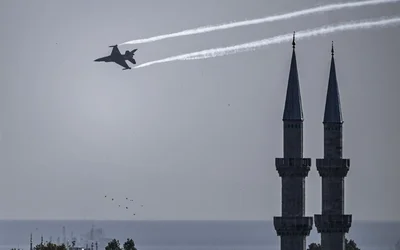
October has become the worst month on record for attacks on commercial shipping in the Strait of Hormuz and surrounding waterways.
There have been 120 incidents in the Strait of Hormuz and the Middle East overall, impacting around 20,000 seafarers, port workers and offshore staff, according to the International Maritime Organisation.
The Strait of Hormuz is a major route for oil and liquefied natural gas shipments, making its stability important to energy-importing economies.
New MEE newsletter: Jerusalem Dispatch
Sign up to get the latest insights and analysis on Israel-Palestine, alongside Turkey Unpacked and other MEE newsletters
Ahead of Cop31, which will be held in Antalya between 9 and 20 November, Ankara is pushing to boost its renewable electricity supply by creating a local carbon trading system and helping industries prepare for the changes.
The summit will bring governments, businesses and civil society together to discuss climate action and the implementation of existing commitments.
Initiatives proposed by Turkey include battery storage, renewable energy certificates, electric harbour tugs, waste reduction and coastal ecosystem protection.
Turkey's organised energy markets operator, Energy Exchange Istanbul, known as Epias, put the country's installed electricity capacity at 127.3 gigawatts as of 10 October, with renewable sources accounting for about 62 percent of the total.
Taha Meli Arvas, Epias's chief executive, told Middle East Eye that the next major step was to improve the ability to store electricity generated from renewable sources.
“For Turkey in general, it’s increasing battery storage capacity and using that to help renewable energy become baseload,” he said.
Epias also operates YEK-G, a renewable energy guarantee-of-origin system that issues, trades and redeems certificates linked to renewable electricity production.
The certificates allow businesses to document the renewable electricity they purchase.
Turkey has also announced that it is establishing a national emissions trading system, which will allow covered companies to trade allowances linked to greenhouse gas emissions.
The system will be piloted in 2026 and 2027. However, 2026 is a monitoring year under current rules and companies included in the system will have to report on their emissions but will not be required to give up allowances. The system’s price mechanism will come into effect in 2027.
Energy transition
Mustafa Aydin, Epias's deputy general director for environmental and minerals markets, told MEE that participating industries could use revenues generated through the system to support investments in their transition.
Turkey's emissions trading system is also being developed as exporters prepare for the European Union's Carbon Border Adjustment Mechanism.

The rules matter for Turkey, whose manufacturers export extensively to European markets.
Companies that cannot provide reliable emissions data or demonstrate how much carbon is embedded in their products could face higher compliance costs.
Arvas said Epias was helping domestic companies understand the new requirements and prepare for the changes.
Turkey's preparations also extend to maritime transport, where battery-powered vessels offer an alternative to conventional diesel propulsion for port operations.
In Tuzla, Navtek naval technologies designs and builds ZeeTug zero-emissions, battery-powered harbour tugboats. The company says four vessels are operational.
Tugboats help manoeuvre and tow ships in ports, and electric propulsion can reduce direct exhaust emissions and noise during operation.
Zero waste
Christian Mensah, an adviser to the Zero Waste Foundation and former secretary to UN-Habitat's governing bodies and chief of intergovernmental relations, has discussed the connections between waste prevention, food systems, urban development and industrial activity in the climate agenda.
Established in 2023, the foundation is promoting initiatives focused on food waste, methane reduction, resource efficiency and the circular economy.
Samed Agirbas, the foundation's president, is working to connect cities, businesses, investors and civil society with the climate process.
The foundation has proposed an Istanbul platform to link zero-waste projects with financing, measure progress and follow up on commitments made around Cop31.
The approach seeks to move waste management beyond disposal and recycling towards preventing waste, improving the use of materials and reducing emissions throughout production and consumption.
Protecting coastal ecosystems
Turkey's climate preparations also include projects to protect marine habitats along its Mediterranean coast.
In the Fethiye-Gocek protected area, a buoy and mooring initiative aims to provide boats with designated places to dock, reducing the need to drop anchors into sensitive seabed habitats.
The Deria digital system maps and manages buoys and moorings to help protect seagrass meadows. These habitats provide shelter and feeding grounds for marine life and can store carbon in their biomass and underlying sediments.
The area is also home to several wildlife species, including sea turtles, dolphins and Mediterranean monk seals.
The Zero Waste Foundation is preparing a protection plan for the Dalyan-Koycegiz area, where Lake Koycegiz connects to the Mediterranean through the Dalyan canals. The landscape includes wetlands, forests and Iztuzu beach, an important nesting site for loggerhead turtles.
The upcoming climate summit gives Ankara an opportunity to present its plans for renewable energy, emissions trading, waste reduction and coastal conservation to an international audience.
For Turkey, the challenge is to demonstrate that its preparations for Cop31 can translate into measurable changes in energy use, industrial emissions and environmental protection.
As attacks on shipping continue to threaten trade through the Strait of Hormuz, the case for more resilient energy systems is becoming harder to separate from the wider climate transition.
Middle East Eye delivers independent and unrivalled coverage and analysis of the Middle East, North Africa and beyond. To learn more about republishing this content and the associated fees, please fill out this form. More about MEE can be found here.