Ratko Mladic is gone. The racial ideology that produced him is not


Many of us will have the fortune of being warmly remembered after death. Others will have the misfortune of being completely forgotten. And then there are those who will be recalled alongside some of humanity’s darkest crimes.
Remembered at his death as the “Butcher of Bosnia”, Ratko Mladic belongs to the last category.
He will forever be remembered as the Serbian general who orchestrated the campaign to ethnically cleanse Bosnia and Herzegovina’s Muslim population. He will be remembered for the murder of around 100,000 people, the displacement of two million, the disappearance of 40,000, and the rape of tens of thousands of Bosniak women and girls between 1992 and 1995.
He will be remembered for the destruction of 614 mosques, 218 prayer rooms, 69 Quran schools and four dervish lodges, alongside countless libraries, archives and museums.
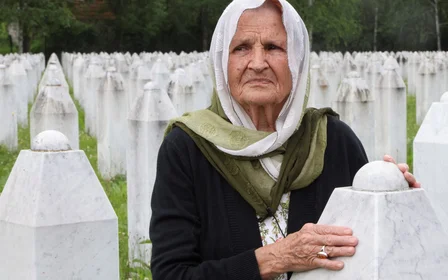
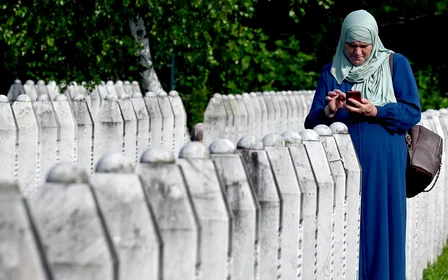
Above all, he will be remembered for Srebrenica: for laying siege to a supposed UN safe area, and cold-bloodedly executing more than 8,000 Bosniak men and boys.
New MEE newsletter: Jerusalem Dispatch
Sign up to get the latest insights and analysis on Israel-Palestine, alongside Turkey Unpacked and other MEE newsletters
No, he will not be remembered kindly. Nor will he be forgotten.
Mladic is dead; good riddance - but also, so what? The man might be gone, but the racial ideology of Serbian nationalism that enabled his crimes is not.
Indeed, it has been given new life in some sections of the global far right. And as these far-right movements swell in number and gain political ground, the spectre of another Bosnia becomes all too real.
Ethnic cleansing
Whether a man convicted of genocide is dead matters far less than whether the political forces that made genocide possible are once again gathering strength.
The ethnic cleansing of Bosniaks - Muslim Bosnians - was driven by a strand of Serbian nationalism that aspired to unite all Serbs within a single, ethnically homogeneous state: Greater Serbia. Its roots can be traced back to the decline of Ottoman rule in the Balkans during the 19th century.
Yet contrary to perspectives that frame Eastern European nationalisms as forms of primordial tribalism or endemic ethnic conflict, Serbian nationalism is recognisable as a racial ideology comparable to those found in Western Europe and across settler-colonial societies, such as North America and Australia.
Genocide is never committed by a single individual, nor do its racial logics disappear after its most notorious architects die
At its a core, a racial ideology operates through three interrelated processes: the differentiation of a population into distinct categories, the hierarchisation of those categories, and the authorisation of the exclusion, expulsion or extermination of the subordinated category.
This is precisely how Serbian nationalism functions. It consolidates the category of the Orthodox Christian Serbian as distinct and privileged, in spite of the shared ethnic lineage of Serbs and Bosniaks.
Although Bosniaks are indigenous Balkan peoples whose ancestors gradually converted to Islam throughout the 500 years of Ottoman rule, Serbian nationalist discourse evicts them from the national collective, recasting them as traitors to Christianity, “Turks”, and thus occupiers of a land they have called home for centuries.
Once designated as foreigners, their mass murder and displacement could be justified as an act of national and religious preservation.
Contrary to popular memory, Serbian nationalism did not first gain political traction in the 1990s. It has a longer history.
During the Second World War, the royalist Serbian nationalist movement known as the Chetniks carried out a campaign of ethnic cleansing against Bosniak Muslims. In Crimes Against Bosnian Muslims 1941-1945, historian Semso Tucakovic documents that villages and homes were burned, mosques were destroyed, and approximately 100,000 Muslim civilians were massacred in a lesser-known Bosnian genocide.
Far-right revival
The Chetniks’ contempt for non-Serbian populations, and their ambitions for creating an “ethnically pure” Serbian state, have been compared to the race thinking that underpinned Nazi conceptions of the Untermensch (non-Aryan “subhumans”) and the pursuit of an exclusively German Lebensraum.
The Bosnian genocide of the 1990s was thus neither an aberration nor a spontaneous eruption of ethnic conflict, but a Balkan manifestation of a very European way of managing non-whiteness.
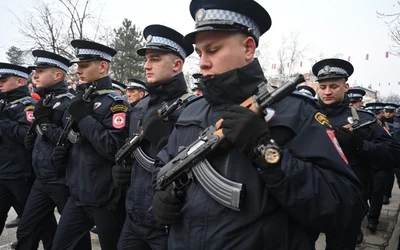
Understanding Serbian nationalism as a racial ideology and genocidal logic is important. It locates the Bosnian case within a longer history of genocide driven by race thinking, including the ongoing genocide of Palestinian people, the Nakba, the Holocaust, the annihilation of Indigenous peoples across settler-colonial states, and countless other colonial genocides.
More importantly, it allows us to sharpen our understanding of our political present, and to see the genocidal dangers posed by the revival and glorification of Serbian nationalism by the rising far right.
For many Europeans, the Bosnian genocide is barely known history. For contemporary far-right movements, however, it is very familiar - and even celebrated.
A Serbian nationalist song written to boost the morale of Bosnian Serb forces during the genocide has become a transnational far-right meme known as “Remove Kebab”. The song was played by Brenton Tarrant in 2019 as he drove to the Christchurch mosques, where he murdered 51 Muslim worshippers. In his manifesto, he described himself as a “kebab removalist”.
Tarrant wasn’t alone. His inspiration and fellow white supremacist, Anders Breivik, who murdered 77 people in Norway in 2011, repeatedly mentioned Serbia throughout his manifesto. He praised Radovan Karadzic, the president of Serbia during the Bosnian genocide and convicted war criminal, as an “honourable Crusader and a European war hero”.
Back to the mainstream
Such references are important. For one, they expose a transnational political imagination in which the massacre of a European Muslim population is a history to be admired and continued in the present.
This alignment can be seen not only in manifestos, but also in nationalist ideologies. The narrative structure of Serbian nationalism is mimicked across the European far-right: non-white categories are expelled from the national collective, marked as immigrants, migrants and asylum seekers.
They are racialised as Muslim, regardless of their actual religious affiliation. Expulsion and violence are framed as necessary for white continuity and survival.
We risk being blindsided by the politics of the far right, unaware of the unfolding conditions that make mass death and expulsion in Europe likely once more
We see this most vividly in the UK, where some far-right groups focus primarily on targeting migrants and migrant accommodation centres. Violence committed by migrants is routinely racialised as “Muslim violence”, and Islam consistently features as the central object of animus at far-right rallies. “Remigration” appears as a key plank of immigration policy, with violence framed as the defence of a white, Christian nation.
Understanding the afterlives of Serbian nationalism in the resurgence of white supremacist movements around the world is crucial. It allows us to see that the ideological scaffolding of the Bosnian genocide survives the death of one of its most zealous proponents.
Mladic is dead. By now, we should know this doesn’t make Muslims safer.
Genocide is never committed by a single individual, nor do its racial logics disappear after its most notorious architects die, are imprisoned, or face trial before international courts. They continue to live on.
They may retreat to the margins of political life, but they continue to circulate through cultural memory. And when the political conditions are right, they are brought back into the mainstream and given political and parliamentary power.
The task is to recognise this reality. Without doing so, we risk being blindsided by the politics of the far right, unaware of the unfolding conditions that make mass death and expulsion in Europe likely once more.
Mladic is dead. The danger he embodied is not.
The views expressed in this article belong to the author and do not necessarily reflect the editorial policy of Middle East Eye.
Middle East Eye delivers independent and unrivalled coverage and analysis of the Middle East, North Africa and beyond. To learn more about republishing this content and the associated fees, please fill out this form. More about MEE can be found here.