Houthis target Saudi Arabia following air strikes as Yemeni forces push towards Sanaa

Forces loyal to Yemen's internationally recognised government have begun a counteroffensive against the Houthis, with officials promising to recapture Sanaa.
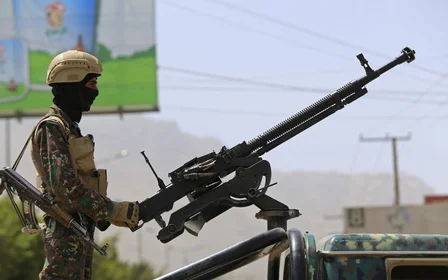
Saudi Arabia-backed government forces said they targeted Houthi positions with rocket and drone strikes as “intensive battles” were ongoing with ground troops in Taiz, Bayda, and Jawf, a province seen as a key gateway to the capital, Sanaa.
Yemen’s Deputy Defence Minister Major General Samir al-Sabri told state television the government had decided to “retake Sanaa”.
Majid al-Nuzaili, a spokesman for the government-aligned forces, said the campaign would “liberate Yemen from the grip” of the Ansar Allah group, otherwise known as the Houthis. “and restore Sanaa as a capital for all Yemenis”.
Pro-government forces said they started a ground offensive toward the al-Labanat mountains in al-Jawf, carried out rocket strikes on Yatma and advanced toward Dhi Na’im district in al-Bayda.
New MEE newsletter: Jerusalem Dispatch
Sign up to get the latest insights and analysis on Israel-Palestine, alongside Turkey Unpacked and other MEE newsletters
Al Jazeera said fighting has escalated in several provinces and threatens to expand the country’s long-running war.
According to Mohammed al-Farah, a member of the Ansar Allah political bureau, the group had pushed back the advance toward al-Labanat as dozens of pro-government fighters were killed or injured.
Houthi forces also targeted reinforcements in al-Jawf with ballistic missiles, he said.
Local media reported air strikes on Houthis west of Taiz.

Saba news agency, which is affiliated with the Houthi movement, reported that seven people were killed by Saudi air strikes on the prison in Al-Hazm in the north of Yemen, including one child visiting the facility.
The latest flare-up has also spilled over Yemen’s borders.
At least 73 civilians, including women and children, were wounded in Houthi attacks on Saudi Arabia's southern provinces.
Riyadh condemned the attacks as a “dangerous escalation” and said it would respond.
Saudi Foreign Minister Prince Faisal bin Farhan said the Houthis are trying to export their own problems to Saudi Arabia and Yemen’s government, which is supported by Riyadh, describing their actions as “selfishness”.
“The road to diplomacy is not closed. Saudi Arabia will always support diplomatic solutions, but the kingdom will never hesitate to defend itself and its interests," he added.
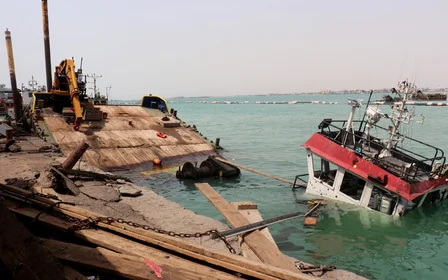
The Saudi Ministry of Energy said in a statement that several “energy sector facilities and installations” in southern areas of the kingdom were hit early on Tuesday.
The attacks wounded a “number of citizens and residents” and sparked “fires at several locations”, forcing a “temporary halt in some operations”, the statement said.
Escalating air attacks
The Houthis say that Saudi Arabia is backing government forces with a major air campaign.
Saudi Arabia launched 121 air strikes across Marib, al-Bayda, Hodeidah, Taiz and al-Jawf, said Ansar Allah military spokesman Yahya Saree, warning that the group would respond with “even stronger and wider strikes”.
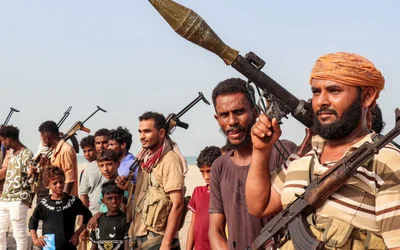
The fighting has also taken on wider regional significance given the war between the United States, Israel and Iran.
The Houthis have announced a blockade of Saudi ships in the Red Sea and Bab al-Mandeb. Iran has restricted shipping traffic in the Strait of Hormuz.
The flare-up is the worst since a United Nations-brokered truce halted large-scale hostilities in 2022.
The conflict erupted in 2014 when the Houthis seized Sanaa, prompting a Saudi-led military intervention the next year.
The World Health Organisation said at least 728 people had been killed or wounded since 23 August, primarily in Taiz and along Yemen’s western coast.
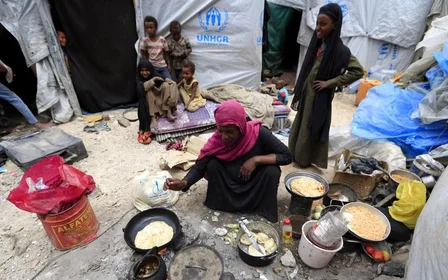
Some 21,000 people have been displaced from Taiz since Thursday, according to multiple reports.
Nabeel Khoury, a former US diplomat and chief of mission in Yemen, said the fighting was a symptom of a wider power struggle in the region.
“This is not a war that is purely Yemeni. This is part of a struggle for dominance in the region,” Khoury said.
Middle East Eye delivers independent and unrivalled coverage and analysis of the Middle East, North Africa and beyond. To learn more about republishing this content and the associated fees, please fill out this form. More about MEE can be found here.