Iranian expat politics has sunk into the swamp of genocidal Zionism


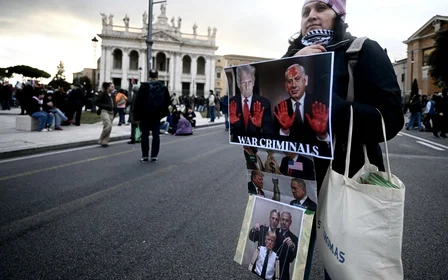
Consider this: with US President Donald Trump's active support and participation, Israel has been engaged in the massive bombing of civilian targets and civil infrastructure in Iran, assassinating Iranian scientists and political and defence officials, destroying bridges and gas and oil reserves, making the toxic air of Tehran unbreathable, targeting university campuses and research institutes, and killing children in their schoolyards.
It has been arming and inciting violent rioters, enabling armed rebellion by separatist forces, bombing prison compounds and permanently damaging Iranian world heritage sites.
Meanwhile, an expat Iranian assistant professor of one thing or another Oriental on an East Coast university campus - let's call her Professor Fatemeh Shaq al-Qamar Khorasani (not a real name, just a character) - has been busy elsewhere.
On her Instagram and X pages, she has been demanding that Trump and Israel's fugitive war criminal Benjamin Netanyahu make any halt to the bombing of Iran and Iranians conditional on freeing her reformist friends from prison.
This is real. I am not making this up.
New MEE newsletter: Jerusalem Dispatch
Sign up to get the latest insights and analysis on Israel-Palestine, alongside Turkey Unpacked and other MEE newsletters
Let us think this through a bit further. As I write, Iraq's oil revenues are deposited into a special account held at the Federal Reserve Bank of New York, from which Iraqis must plead and beg to have a portion of their own money sent to them. This is very old-fashioned colonialism.
Trump was even more blunt in deposing the Venezuelan government and taking possession of its oil.
Observers have lost count of how many times Trump has threatened to obliterate Iran, Iranians and Iranian civilisation from the face of the earth
These are the men - the US president and his Israeli puppet master - to whom Fatemeh Shaq al-Qamar appeals to make halting the bombing of Iranian civilians contingent on the freedom of Iranian political prisoners, who range from reformists to monarchists to leftists.
Yes indeed, they should all be released immediately, so that the world gets to know them for who and what they are.
Another thing. Observers have lost count of how many times Trump has threatened to obliterate Iran, Iranians and Iranian civilisation from the face of the earth.
Aboard Air Force One on 7 March 2026, speaking to reporters, Trump said of Iran's rulers that they were "among the most evil people ever on earth… They cut babies' heads off. They chop women in half." On 21 March he threatened to "obliterate" Iran's energy infrastructure.
On 7 April he warned that a "whole civilization will die tonight". On 11 June he threatened "total control" of Iran's oil and gas industries. To this man, Fatemeh Shaq al-Qamar Khorasani appeals not to stop the bombing until she says so.
What the travelogues taught
This obscene spectacle needs a bit of historical context. How did the expat Iranian community reach this point of vulgarity, actively siding with Israel and Trump as they bomb their homeland, mass murder Iranians and destroy the very foundations of their own country and its heritage?
From the late 18th century, throughout the 19th and well into the 20th, Iranians travelled around the world, and not just "to the West". They wrote engrossing travelogues in Persian, brought their accumulated worldly wisdom back to their homeland and helped their compatriots navigate a wiser and more learned encounter with the world around them.
I studied more than a dozen of these travelogues in my book Reversing the Colonial Gaze: Persian Travelers Abroad (2020).
The point of that study was to map out in detail how Iranians who had left their homeland for a variety of reasons brought back to it a collective consciousness of the historic changes happening around the world, changes that demanded a more progressive politics at home. Generations of anticolonial struggle in Iran were informed by these travelogues.
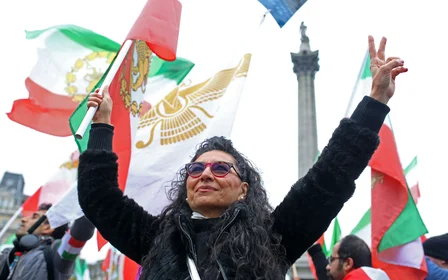
In an earlier volume, Iran Without Borders: Towards a Critique of the Postcolonial Nation (2016), I had already detailed how expat Iranian communities around the world helped shape Iranian national identity and the country's collective destiny. Since at least the early 19th century, expat Iranians have played a significant role in the arts, literature and politics of their homeland.
The first modern Persian novel was published in Cairo. The first Persian-language sound film, Dokhtar-e Lor (1933), was made in India. The pioneering Iranian periodicals of the constitutional era were published in Istanbul, Berlin, Cairo and Calcutta.
Sadegh Hedayat published his masterpiece The Blind Owl (1936) in Bombay. Hasan Taghizadeh published his groundbreaking periodical Kaveh (1916-1922) in Berlin. Zeyn al-Abedin Maragheh'i published his Safarnameh Ebrahim Beik (1897) in Cairo.
When it was banned in Iran, Ali Akbar Dehkhoda published his revolutionary periodical Sur-e Esrafil (1907-1909) from Yverdon in Switzerland. During the pivotal years of the late 19th century, leading to the Constitutional Revolution of 1906-1911, towering Iranian intellectuals such as Mirza Agha Khan Kermani, Sheikh Ahmad Ruhi and Mirza Habib Isfahani were residents of Istanbul.
The list of these luminaries unfolds from Central Asia to Ottoman territories, deep into Europe, and back to India and Egypt. Learned Iranians travelled or even lived abroad, yet remained central to the progressive politics of their homeland.
How did we get from there to the notorious likes of Azar Nafisi, Masih Alinejad and this Fatemeh Shaq al-Qamar character today?
The native informers
After the Constitutional Revolution and well into the first Pahlavi period, the leading Iranian elite were mostly educated in Europe and went back to Iran to recast the very shape of their nation.
Towering figures such as Mohammad Ali Foroughi, Hasan Taghizadeh, Mirza Malkam Khan and Hasan Pirnia, each shaped by years spent abroad, revolutionised Iranian prose and politics.
In the aftermath of the CIA-MI6 coup of 1953, the Confederation of Iranian Students played a key role in articulating a progressive politics.
The MeK cult has not had an iota of credibility with Iranians inside Iran. The same goes for the last shah's son Reza Pahlavi
A key feature of the confederation, which has been the subject of significant scholarship, was the active solidarity of US-based Iranian students with all the progressive causes of their time, from the civil rights movement in the US to Palestinian liberation abroad.
In the decades after the Iranian revolution of 1977-1979 and the militant Islamist takeover, the widespread repression of political dissent inside Iran forced leading Muslim intellectuals such as Abdolkarim Soroush, Mohsen Kadivar and Akbar Ganji into exile.
In the social uprisings that followed, from the Green Movement of 2009-2010 to the Woman, Life, Freedom uprising of 2022-2023, there were still legitimate expat voices helping to promote the cause of democracy in their homeland.
Signs were already evident, however, of a takeover by the deeply corrupt Pahlavi monarchist Zionists, by the Mujahedin-e Khalq (MeK) cult and by a coterie of US government-funded regime changers based in neoconservative think tanks.
The Hoover Institution's "Iran Democracy Project" and the National Endowment for Democracy are paramount examples of the reactionary drive to overthrow the government in Iran, which has advanced through a combination of crippling economic sanctions, covert separatist operations, targeted assassinations and, ultimately, to the delight of genocidal Zionists, massive military strikes.
The publication of Azar Nafisi's Reading Lolita in Tehran (2003) was the earliest sign that a generation of Iranian expat immigrants had come to the US to cash in as native informers to the dysfunctional US empire. Nafisi's notorious "memoir" became a national bestseller with the active support of US neoconservative operatives such as Paul Wolfowitz.
Nafisi subsequently recycled her highly useful literary spectacle with the Israelis to turn it into a film in 2024, a year into the Gaza genocide, and paving the way for the Israeli-US war on Iran in June 2025 and again in February 2026.
The notorious Zionist stooge Masih Alinejad became another useful charlatan, who upped the ante and superseded Nafisi in her services to American Zionists.
In the aftermath of the Israeli-instigated and US-supported war on Iran, the entirety of Iranian expat politics has become categorically suspect, useless when not harmful to the fate of the nation, which is now being defended by the very Islamic Republic that has been the source of mayhem, murder and repression inside Iran.
Ever since it sided with Saddam Hussein during the 1980-1988 Iran-Iraq war, the MeK cult has not had an iota of credibility with Iranians inside Iran.
The same goes for the last shah's son Reza Pahlavi since he banked his delusions of a return to the Peacock Throne on the architect of the Israeli genocide in Gaza, Benjamin Mileikowsky, aka Netanyahu.
Irrelevant at home and abroad
A key element in this degeneration of expat politics is the pernicious role of the expat media, particularly Manoto TV, Iran International and BBC Persian, which are notorious for crafting and sustaining a nefarious anti-Iranian politics.
Compare this with the glorious history of the periodicals published since the early 19th century in Bombay, Cairo, Istanbul, Berlin and London, from Sorayya and Habl al-Matin all the way to Iranshahr, which the poet Ahmad Shamlou published from London in 1978-1979.
The only politics that matters to Iranians today is the one unfolding inside Iran, whether for or against the government
Add to all of this a useless, when not harmful, Iranian expat professoriate, the Iranian studies crowd who dare not utter a word on behalf of any progressive cause, whether Palestine or Black Lives Matter, yet become garishly gung-ho against the very people who are right now protecting the territorial integrity of their homeland.
Look at their ignoble names: not a single one of them has ever been integral to any progressive movement outside their homeland. They are nativist to the colonised marrow of their hollowed backbones.
This is the end of the expats' political relevance. They are irrelevant inside Iran, and they are parasitical and a cause of embarrassment outside it.
They form a useless reactionary gang who will never have anything to do for, say about or contribute to their homeland, while remaining entirely nameless and faceless in their host countries: a truly pathetic dual marginality, irrelevant where they live and a cause of harm to what was once their homeland.
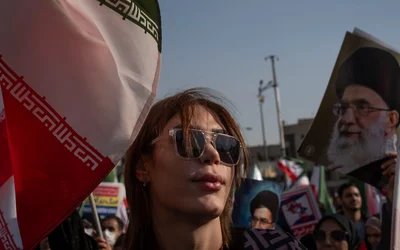
The only politics that matters to Iranians today is the one unfolding inside Iran, whether for or against the government. That is where the future destiny of Iran will be articulated.
Brown skin, white masks
What sort of miserable life these parasites lead outside Iran is determined by a slave morality that has been consistently articulated and theorised from Hegel to Nietzsche to Malcolm X, Edward Said and Frantz Fanon.
My own contribution to this mode of critical thinking first appeared in Brown Skin, White Masks (2011), where, building on Fanon, Said and Ngugi wa Thiong'o in particular, I looked at how colonised comprador agents of empire internalise feelings of racial inferiority by putting themselves at the service of a fragile and dysfunctional hegemony.
We have known since Hegel's "master-slave dialectic", which first appeared in his Phenomenology of Spirit (1807), that these expat native informers, house slaves in their adopted empire, can never be recognised as equals by their masters. However much they try to appease them, they are loathed all the more.
In Brown Skin, White Masks, I focused in particular on immigrant academics and writers, on the model of Fouad Ajami, Kanan Makiya and Azar Nafisi during the Iraq war, who acted as comprador intellectuals and guns for hire.
US imperial hubris uses such figures to misrepresent their home countries and to manufacture public consent for military interventions and foreign occupations.
To make that argument, I needed to correct Said's positive framing of the intellectual exile, in order to argue that some immigrant charlatan "activists" find a lucrative business in telling their masters what they wish to hear.
Reza Pahlavi, the MeK's Maryam Rajavi, Azar Nafisi, Masih Alinejad, ad nauseam, and now this Fatemeh Shaq al-Qamar Khorasani character type are today the prototype of the expat Iranian comprador intellectual, ushering what was once a glorious community of thinkers and activists into the swamp of genocidal Zionism.
The views expressed in this article belong to the author and do not necessarily reflect the editorial policy of Middle East Eye.
Middle East Eye delivers independent and unrivalled coverage and analysis of the Middle East, North Africa and beyond. To learn more about republishing this content and the associated fees, please fill out this form. More about MEE can be found here.