Iran warns citizens against travel to France, Belgium and Italy amid violent unrest

The Iranian foreign ministry has advised its citizens to avoid non-essential travel to France, Belgium and Italy following the “intensification of unrest and disruption of public order” in those countries.
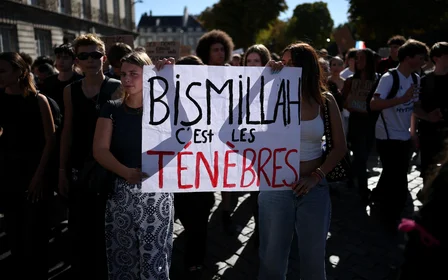
The ministry issued the advisory on Monday as France faced increasingly violent protests driven partly by a cost-of-living crisis worsened by the Israeli-US war on Iran.
“Compatriots currently in France, Belgium and Italy are advised to avoid being in tense areas and conflict zones and to avoid unnecessary travel, especially in unstable areas,” the Iranian foreign ministry said.
At least two people have died during the protests in France, while police have arrested at least 2,000 people.
Reports of serious injuries among protesters include two who lost their hands to stun grenades.
New MEE newsletter: Jerusalem Dispatch
Sign up to get the latest insights and analysis on Israel-Palestine, alongside Turkey Unpacked and other MEE newsletters
Iranian Foreign Minister Abbas Araghchi condemned French President Emmanuel Macron on X for siding with US President Donald Trump in the war against Iran.
“Macron made his bed when he assured POTUS that he welcomes atrocities against Iranians,” said Araghchi on Monday.
“Too late to blame the war his ilk helped cause. The French people demand wholesale change, including freedom of assembly. Listen to the future of France, Mr President,” added Araghchi.
Authorities in French cities have also banned protests, while the government has refused to rule out a state of emergency that would expand police powers to conduct searches and make arrests.
Amnesty International has condemned French police for using unnecessary and disproportionate force against the mainly student protesters.
The president of Amnesty International France, Anne Savinel-Barras, said: “Children and young people peacefully demanding their right to education must be protected rather than being beaten, tear-gassed, or arbitrarily detained.”

In the Paris suburbs, police fired a tear-gas projectile into the face of a 14-year-old boy named Eden, breaking his jaw and smashing his teeth, Reuters reported.
Tehran’s rebuke challenges the credibility of a government that has supported protests in Iran while cracking down on demonstrations at home.
On 6 October, Iranian foreign ministry spokesman Esmaeil Baghaei accused France of double standards over its condemnation of repression in Iran during mass street protests earlier this year.
“In January 2026, France spoke of the need to respect 'peaceful assembly without fear of punishment' in Iran, and to exercise “restraint” on the part of the government towards protesters,” said Baghaei, arguing that Paris had taken that position despite “incitment to riots” in Iran.
“In France, student protests are now being called 'urban violence.' The interior minister is not very supportive of restraint, calling for swift and decisive intervention by security forces and the use of force to restore order,” noted Baghaei.
“Why are the same behaviors and the same standards interpreted one way when the protester is in Iran and another way when the protester is in France?!” he added.
Thousands of people were reported to have been killed in a brutal crackdown by Iranian authorities following mass street protests in January, with security forces opening fire on crowds with live fire and arresting thousands.
At the time, Amnesty International said: “Even by the Iranian authorities’ own bleak record of committing gross human rights violations and crimes under international law during successive waves of protests, the severity and scale of killings and repression since 8 January is unprecedented.”
On 7 October, French Foreign Minister Jean-Noel Barrot summoned Iran’s ambassador to France over what Paris described as a “disinformation campaign carried out by the Iranian authorities regarding the high school student movement in France”.
Middle East Eye delivers independent and unrivalled coverage and analysis of the Middle East, North Africa and beyond. To learn more about republishing this content and the associated fees, please fill out this form. More about MEE can be found here.