French student protests: A generation that sees no future is rising up


Since late September, France has lived to the tempo of massive high school student protests and blockades, culminating this week in a nationwide demonstration that brought out hundreds of thousands of people across the country.
Originating in a low-income suburb of Paris, the movement spread like wildfire across France, quickly expanding to encompass university students and union activists.
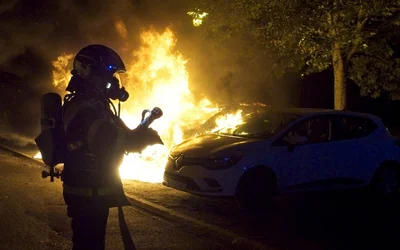
While the movement is mostly made up of teenagers who have overwhelmingly remained peaceful, state authorities have responded with disproportionate force.
Rather than insisting on moderation, Interior Minister Laurent Nunez called for police to use the full range of intermediate weapons, such as tear gas and rubber bullets, as necessary on protesters. More than 6,000 people, mostly minors, have been arrested in the crackdown.
Predictably, since day one, the mainstream media has worked hand-in-hand with the Macron government to discredit the movement, showing almost exclusively the more sensationalist, scary and spectacular images from the protests.
New MEE newsletter: Jerusalem Dispatch
Sign up to get the latest insights and analysis on Israel-Palestine, alongside Turkey Unpacked and other MEE newsletters
The coverage aims to create the false impression that “France is burning”, presenting the protests as “violent riots”, rather than as a largely peaceful student movement with legitimate and reasonable demands.
Deliberately ignored in such coverage is the fact that the vast majority of the countless protests, blockades, marches and actions in recent days, including the massive nationwide demonstration this week, remained non-violent.
Media coverage has also portrayed the students as being manipulated or instrumentalised by the France Unbowed party and its leader, Jean-Luc Melenchon, who is running in next year’s presidential election. They have presented no evidence for this claim, beyond the party’s support for the youth movement.
Enter Trump
Beating the French media and politicians - from the centre left to the far right - at their own Islamophobic and racist games, US President Donald Trump recently weighed in by publicly blaming the protests on uncontrolled mass migration and Islam.
Such outlandish accusations hardly deserve a response, and in France, they have essentially been ignored as the ravings of a despicable lunatic.
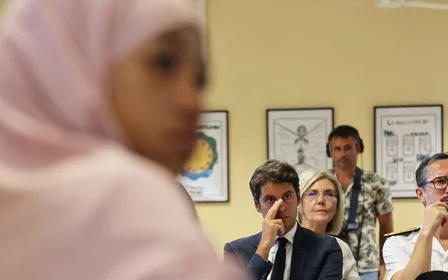
Students complain about severe underfunding of the public education system, even as the state spends billions of dollars in subsidies on private, usually Catholic schools
There are, however, two other explanations. Trump and others in his entourage might genuinely believe in the Great Replacement fantasy that “European civilisation” is being eclipsed by Muslims and Arabs, who want to build some sort of “Islamist caliphate”. Alternatively, he might simply be playing to his largely xenophobic Maga base, ahead of November midterms that his party is poised to lose.
But Trump’s grotesque posturing as a defender of “western civilisation” against invading hordes from the Global South does not seem to have swayed many people, even in the US, likely because few American voters have much interest in the politics of France.
The reasons for the protests are much simpler than Trump suggests. They have been abundantly, even relentlessly, explained by the students themselves, as well as by some good, honest reporting and expert commentary.
Despite vast disparities across the nation, the primary grievances of students include the often appalling physical conditions of their crumbling schools; severe and systematic shortages of teachers and support staff; and overcrowded classrooms, where the numbers of students sometimes exceed available chairs.
In general, students complain about severe underfunding and governmental neglect of the public education system, even as the state spends billions of dollars in subsidies on private, usually Catholic schools - a cruel irony for a supposedly secular state whose elected officials constantly brag about the strictness of French laicite.
Restless generation
Another reason cited by student protesters is the strong and mounting anxiety they feel about their prospects for the future. This deep-seated fear crystallises around a state-run web portal called “Parcoursup”, which launched in 2018 with a goal of sorting out university applications.
Widely viewed as a failure, the automated selection system pits students against other students for their choice of universities and specialisations, in a process that has been criticised as opaque and discriminatory.
While France legally guarantees postsecondary access for students who have completed high school, 320,000 students were left without a place last year by the Parcoursup platform. In a nation of just 2.26 million high school students, many of whom will not even apply for higher education, the ratio is worrying.
And this is just the tip of the iceberg. History shows that behind concrete, practical and material demands, and beyond massive and spectacular popular demonstrations, larger problems often loom.
What we are hearing in France is an expression of generalised anxiety over the future, both individually and globally, and a rejection of the state of affairs at home after a decade of disastrous Macronism, which has broken the country and greatly aggravated inequalities, deepening the divide between rich and poor, and thrusting most of the population into ever-worsening precarity.
Researchers have suggested that young people in Generation Z will be worse off than their parents, facing a more difficult path to adulthood than any generation in half a century. Such is the future many of these student protesters see in front of them.
Add to this their emerging awareness that AI is killing and replacing many of the jobs that were supposed to be theirs, and there is no need to see the hands of shadowy “Islamists” behind this historic movement.
The views expressed in this article belong to the author and do not necessarily reflect the editorial policy of Middle East Eye.
Middle East Eye delivers independent and unrivalled coverage and analysis of the Middle East, North Africa and beyond. To learn more about republishing this content and the associated fees, please fill out this form. More about MEE can be found here.