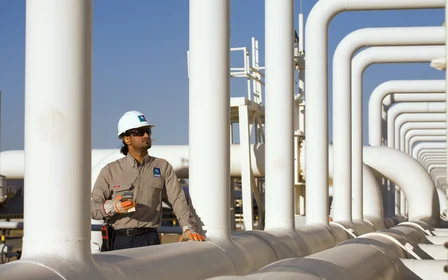

Saudi Arabia says it closed vital East-West Pipeline after attack

Saudi Arabia has shut down its East-West Pipeline after it was attacked on Thursday, closing a key outlet for Middle Eastern oil that has helped keep energy prices in check amid the US-Israeli war on Iran.
“An official source at the Ministry of Energy stated that the East–West Pipeline in Riyadh and Medina regions was subjected to multiple attacks on the morning of Thursday, September 10, 2026,” the official Saudi Press Agency said on Thursday.
“The pipeline was shut down as a precautionary measure," the statement said, without adding when the pipeline would reopen.
Social media posts on Thursday showed large plumes of black smoke, claiming the pipeline was attacked in multiple locations.
The attack came as Yemen’s Houthis conducted a lightning offensive along the Red Sea, bringing their military all the way to the Bab el-Mandeb chokepoint. The sweeping gains put the Houthis in a position to control shipping.
New MEE newsletter: Jerusalem Dispatch
Sign up to get the latest insights and analysis on Israel-Palestine, alongside Turkey Unpacked and other MEE newsletters
The Houthis previously used drones and missiles to fire on ships, but now can use standard artillery.

Saudi Arabia did not say who was responsible for the attacks on the East-West Pipeline. CNN reported earlier on Thursday that the pipeline had been hit by drones originating from Iraq.
Iraqi Shia militias and Yemen’s Houthis are aligned with Iran. They have coordinated in the past, with the Houthis believed to be sending advisors to Iraq and Iraqi militias sending technicians to the Houthis.
The East-West Pipeline was built by Saudi Arabia in the 1980s as a bypass to the Strait of Hormuz during the Iran-Iraq war. It runs from the kingdom’s oil fields on the Gulf coast to the Red Sea port of Yanbu.
The pipeline allowed Saudi Arabia to export about a third of its pre-war oil volume, even as other Gulf producers, like Qatar, Kuwait and Bahrain, have been prevented from exporting crude.
The UAE has continued exports using ships with their trackers turned off and a small pipeline terminating outside the Strait of Hormuz.
The closure of the East-West Pipeline underscores the vulnerability of any Strait of Hormuz bypass routes, with talks aimed at ending the war all but collapsed.
The Financial Times reported that Gulf states are expected to meet with Iran next week to discuss how to resume shipping in the Strait of Hormuz in talks brokered by Oman.
Oil prices have soared above $100 per barrel this week, responding to the Houthis' control of the Bab el-Mandeb Strait. The group says it is imposing an embargo on Saudi Arabian oil shipments, and diplomats say it is eyeing a toll in the waterway akin to what Iran has tried to establish in the Strait of Hormuz.
Middle East Eye delivers independent and unrivalled coverage and analysis of the Middle East, North Africa and beyond. To learn more about republishing this content and the associated fees, please fill out this form. More about MEE can be found here.